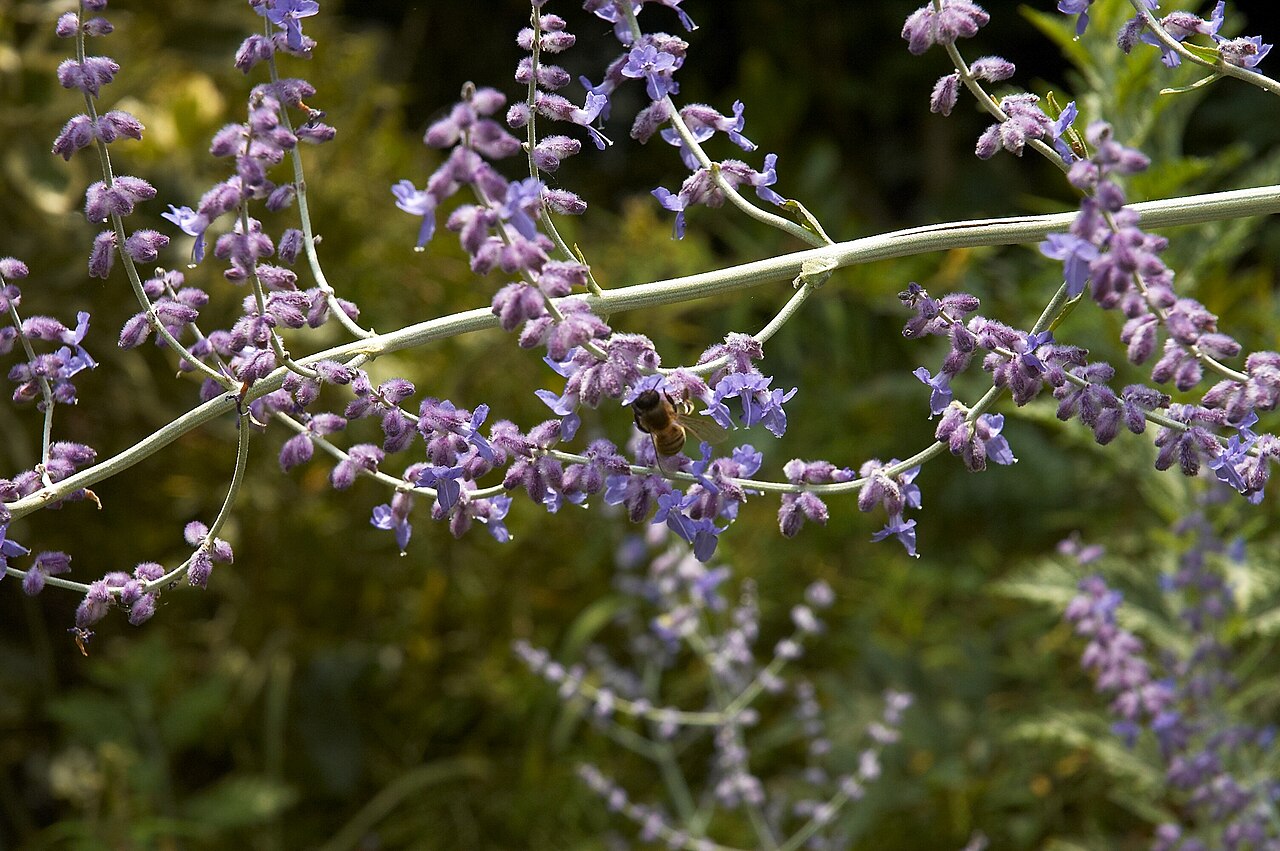
Russian sage brings a haze of lavender-blue to the garden from midsummer until frost. Its long, branching spikes of tiny flowers rise above silvery, finely cut leaves on pale stems, giving the plant an airy, cloudlike look that softens bold neighbors and glows in evening light. The leaves smell sharply of sage when brushed, which is one reason deer and rabbits leave it alone.
Few perennials are tougher. Russian sage thrives in heat, drought, poor soil and full sun, and it is one of the best choices for hot, dry beds, gravel gardens and slopes. Most problems come from treating it too well: rich soil, shade and extra water make it floppy, while wet winter soil can kill it. The only real chore is a hard cutback each spring.
How Do You Grow Russian Sage?
Grow Russian sage in full sun and lean, well-drained soil in USDA zones 4 to 9, spacing plants 2 to 3 feet apart. Water only until established, skip fertilizer and avoid wet soil. Leave the stems standing over winter, then cut them back to about 6 to 12 inches in early spring when new buds appear. It blooms from early summer to fall, peaking in mid to late summer.
| Botanical name | Salvia yangii, formerly Perovskia atriplicifolia |
|---|---|
| Common names | Russian sage, perovskia, Afghan sage |
| USDA zones | 4 to 9 |
| Sun | Full sun, at least 6 hours of direct light |
| Height | 18 inches to 4 feet, depending on variety |
| Spread | 2 to 4 feet |
| Bloom time | Early summer to fall, peaking in midsummer to late summer |
| Grown for | Both flowers and foliage |
| Flower color | Lavender, light blue, violet |
| Soil moisture | Dry to average, well drained |
| Deer | Resistant |
| Drought tolerance | Very high once established |
| Native range | Central Asia, from Afghanistan and Pakistan to Tibet and western China |
| Pet toxicity | Not known to be toxic; not a culinary sage |
| Maintenance | Low; cut back once a year in spring |
What Is Russian Sage?
Despite its name, Russian sage is not from Russia, and it is not the culinary sage used in cooking. It grows wild in the dry, rocky mountains of Central Asia, from Afghanistan and Pakistan to Tibet, at elevations up to about 8,000 feet. The name honors a Russian general, Vasily Perovsky, after whom the genus Perovskia was named.
For most of its garden history, it was known as Perovskia atriplicifolia. In 2017, botanists studying the relationships within the sage family moved the whole Perovskia genus into Salvia, the true sages, and Russian sage became Salvia yangii. Nurseries still sell it under both names, and you will often see Perovskia on plant tags.
Russian sage is technically a subshrub. It grows from a woody base, and in mild climates the lower stems can survive winter above ground. In colder zones it behaves like a herbaceous perennial, dying back to near the ground and regrowing from the base each spring. It was named Perennial Plant of the Year in 1995 by the Perennial Plant Association.
Where Russian Sage Grows Best
Russian sage is hardy in USDA zones 4 through 9, and it thrives in hot, dry summers. In an eight-year trial at the Chicago Botanic Garden, plants survived a severe winter with lows of -23°F, regrowing from the stems that were buried under about 8 inches of snow.
Full sun is essential. Give Russian sage at least 6 hours of direct light a day, and more if possible. In part shade, the stems stretch, lean toward the light and fall open, and the plants flower less.
The single most important requirement is drainage. Russian sage grows best in lean, sandy, gravelly or rocky soil and tolerates poor, dry ground, as well as acidic or alkaline soil. It will not survive in soil that stays wet, especially in winter, when the roots rot. Heavy clay is acceptable only if it drains; otherwise, plant on a slope or in a raised bed. Avoid rich compost and fertilizer, which make the plants tall and floppy.
How to Plant Russian Sage
Plant Russian sage in spring after the last frost, which gives it a full season to establish before winter. Early summer planting also works if you water regularly. Fall planting is riskier in cold zones, since the plants need time to root before the ground freezes.
Dig a hole as deep as the pot and about twice as wide, set the plant so the top of the root ball is level with the soil surface and backfill with the native soil without adding compost. Water well. Space plants 2 to 3 feet apart, or 18 to 24 inches for dwarf varieties. Use gravel or no mulch at all around Russian sage rather than heavy wood mulch, which holds moisture against the stems.
Watering and Feeding
Water new plants about once a week during their first summer if rain is scarce, letting the soil dry between waterings. Once established, Russian sage rarely needs extra water and is one of the most drought-tolerant perennials you can grow. Overwatering is far more harmful than drought.
Russian sage needs no fertilizer. Extra nutrients produce soft, lanky growth that flops, and plants in rich soil often split open in the middle by late summer.
Pruning Russian Sage
Pruning is the one job Russian sage really needs, and timing matters. Leave the stems standing through winter. The silvery stems and seed heads look attractive in snow, and the old growth helps protect the woody base from cold.
In early spring, when you see small green buds or new leaves emerging near the base of the stems, cut the whole plant back to about 6 to 12 inches above the ground, just above a set of new buds. Cutting back hard every year keeps the plant compact, encourages strong new stems and produces more flowers. Plants left unpruned become woody, sprawling and sparse. In cold zones where the stems die back further, cut down to where you see live buds.
Avoid cutting Russian sage back in fall. Hard pruning before winter can stimulate new growth that is damaged by cold, and it removes stems that insulate the crown. If a plant is badly overgrown or flopped over by late fall, you can trim it back lightly to about 12 inches and finish the job in spring.
The Chelsea Chop
To keep tall varieties more compact and upright, cut the stems back by about a third in late spring, when they are about 12 to 18 inches tall. The plants branch more, stay sturdier and bloom a little later.
Keeping Russian Sage from Flopping
Russian sage often leans or falls open in the center, especially when young or in its second half of summer. The causes are almost always too much shade, rich or moist soil, fertilizer or skipped spring pruning. Grow it in full sun and lean soil, cut it back hard every spring and try the Chelsea chop on tall types. Compact varieties such as ‘Little Spire’ and ‘Blue Jean Baby’ stand up better on their own. Planting Russian sage among ornamental grasses or sturdy perennials also gives the stems natural support.
Propagating and Dividing Russian Sage
Russian sage has a deep, woody root system and does not need regular division. Clumps spread slowly over the years, and some plants send up new shoots from underground stems a short distance from the main crown. These suckers can be dug up with some roots in spring and replanted.
The easiest way to make new plants of named varieties is from softwood cuttings in late spring or early summer. Take 3- to 4-inch tips from new growth, remove the lower leaves, dip the ends in rooting hormone and root them in a gritty mix kept lightly moist. Seed-grown plants vary in habit and flower color.
Best Russian Sage Varieties
The Chicago Botanic Garden evaluated 14 Russian sage varieties over eight years, from 2013 to 2020, and several of the varieties below earned its top rating.
‘Denim ‘n Lace’
A top-rated variety with sturdy, upright stems about 33 inches tall and deep lavender-blue flowers. It spreads wider than most, to about 4 feet, making it a good choice for mass plantings.
‘Blue Jean Baby’
A compact, top-rated variety about 30 inches tall with dense, upright stems and blue-violet flowers. Its tidy habit makes it a good fit for smaller gardens.
‘Blue Steel’
Another top-rated variety, about 32 inches tall, with stiff stems and rich blue flowers held on a well-branched, upright plant.
‘Little Spire’
A dwarf variety 18 to 24 inches tall with an upright habit that resists flopping. It suits the front or middle of the border and large containers.
‘Blue Spire’
A classic taller variety, 2 to 3 feet or more, with deep violet-blue flowers and finely divided silver leaves. It is widely available and makes a strong vertical accent at the back of a border.
‘Longin’
An older variety with stiff, narrowly upright stems and less divided leaves, grown for its formal, columnar habit.
Companion Plants for Russian Sage
Russian sage combines well with other sun-loving, drought-tolerant plants. Ornamental grasses such as switchgrass, little bluestem, feather reed grass and fountain grass complement its airy texture. For color contrast, pair it with yellow and gold flowers such as black-eyed Susan, yarrow, coreopsis and daylilies, or with the pink and purple of coneflowers, sedum and phlox. In gravel and Mediterranean-style gardens, it pairs naturally with lavender, catmint, salvia and lamb’s ear.
Russian Sage for Pollinators
The small tubular flowers attract bees, butterflies and hummingbirds over a very long season, from early summer into fall. Honeybees and bumblebees are especially frequent visitors, and a large clump in full bloom often hums with activity through the heat of midsummer.
Common Russian Sage Problems
Russian sage has essentially no serious pest or disease problems, and deer and rabbits avoid its aromatic leaves. Nearly every problem comes from growing conditions.
Root Rot
Soil that stays wet, especially in winter, causes the roots and crown to rot. Plants may fail to return in spring or wilt and die suddenly in summer. Grow Russian sage only in well-drained soil and never water it heavily once established.
No New Growth in Spring
Russian sage is one of the later perennials to break dormancy, often not showing new buds until mid to late spring. Before giving up on a plant, scratch a stem near the base; green tissue underneath means it is alive. Wait for new growth before cutting back so you know how far down the live buds are.
Spreading and Suckers
Some older plants send up new shoots at a distance from the crown. Dig out unwanted shoots in spring, or replant them elsewhere.
Growing Russian Sage in Containers
Dwarf varieties such as ‘Little Spire’ grow well in large containers at least 16 to 18 inches wide. Use a gritty, fast-draining mix, such as potting mix blended with about one third coarse sand or perlite, and a pot with drainage holes. Place it in full sun and water only when the top couple of inches of mix are dry. In zones colder than 6, move the pot to an unheated garage or sink it into the ground for winter.
Frequently Asked Questions
These are the questions gardeners ask most about Russian sage.
When Should You Cut Back Russian Sage?
Cut Russian sage back in early spring, when new buds or leaves appear near the base of the stems. Cut the stems to about 6 to 12 inches above the ground. Avoid hard pruning in fall.
Does Russian Sage Spread?
Russian sage clumps widen slowly over time, and some plants send up shoots from underground stems nearby. It is not usually invasive in gardens, and unwanted shoots are easy to dig out.
Why Is My Russian Sage Falling Over?
Russian sage flops when it grows in too much shade, rich or wet soil or when it is not cut back each spring. Move it to full sun and lean soil, prune it hard in spring and choose compact varieties.
Is Russian Sage the Same as Culinary Sage?
No. Russian sage is Salvia yangii, an ornamental plant from Central Asia, while culinary sage is Salvia officinalis. Although both are now in the same genus, Russian sage is not used for cooking.
Is Russian Sage Deer Resistant?
Yes. The strongly aromatic leaves make Russian sage one of the most reliable deer- and rabbit-resistant perennials.
Sources
- Russian Sage, University of Wisconsin–Madison Division of Extension
- An Evaluation Study of Russian Sage Cultivars, Chicago Botanic Garden
- Russian Sage, The Morton Arboretum
- Perovskia, 1995 Perennial Plant of the Year, Perennial Plant Association