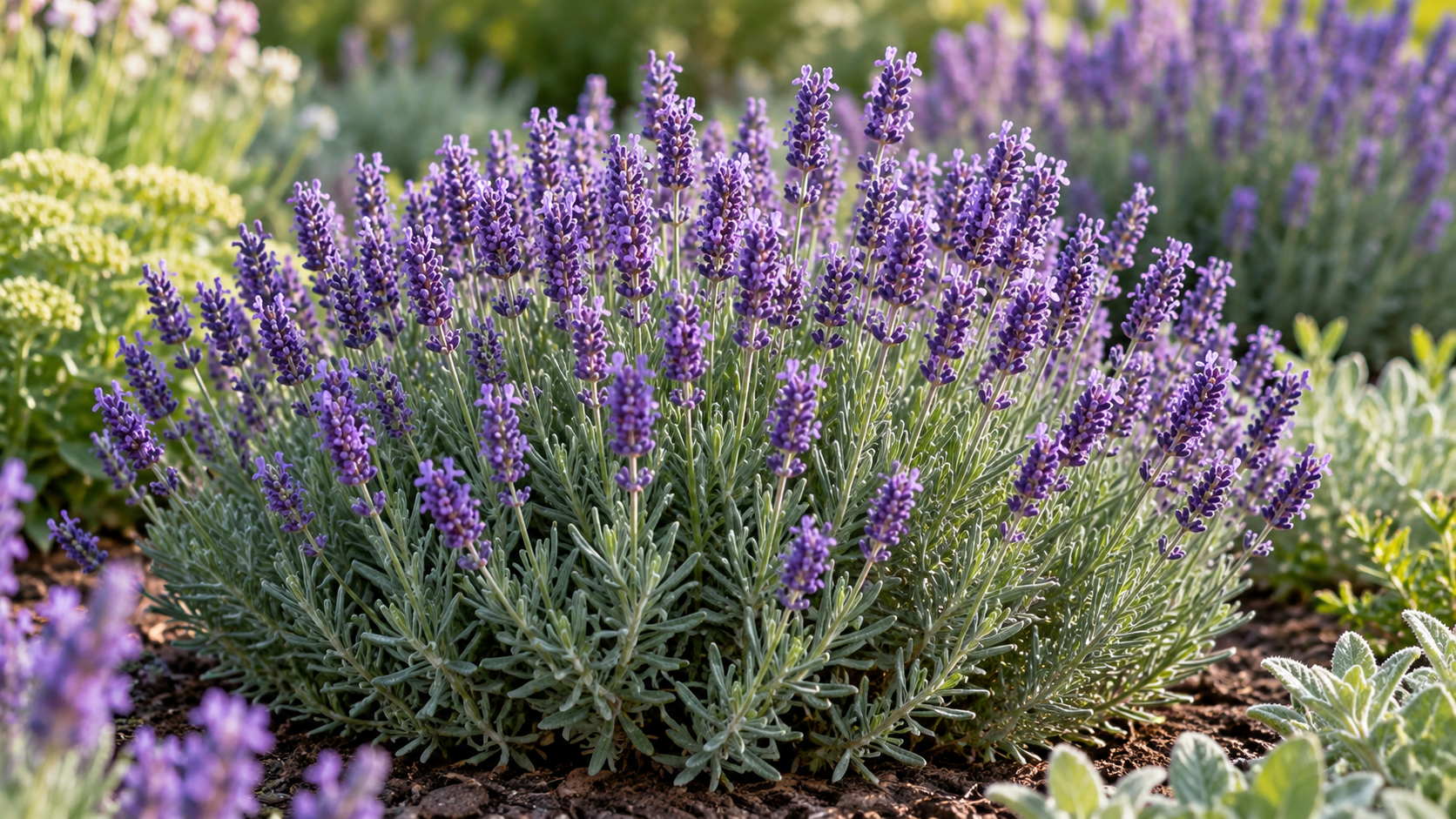
Lavender brings the scent and silvery color of the Mediterranean into the garden. Its spikes of purple flowers hum with bees in early summer, its gray-green foliage looks good for most of the year, and every part of the plant is fragrant. Lavender is also more particular than most perennials. It is not hard to grow, but it needs conditions close to its native hillsides: full sun, lean soil and sharp drainage. Give it those and it thrives on neglect; plant it in rich, damp soil and it rarely survives its first winter.
The other key to success is choosing the right type. English lavender and its hybrid cousin lavandin are hardy in much of North America, while Spanish and French lavenders are much more tender. Pruning matters too, because lavender is a woody subshrub that will not regrow from old, bare stems.
Quick Answer
Grow English lavender (Lavandula angustifolia) or lavandin in full sun and very well-drained, lean soil in USDA zones 5 to 9. Water sparingly once established, skip fertilizer, and never let the roots sit wet. Prune after the first bloom and again lightly in spring, cutting back by about a third but never into bare, woody stems, which do not resprout.
| Botanical name | Lavandula spp. |
|---|---|
| Common names | Lavender, English lavender, lavandin |
| USDA zones | 5 to 9 (English lavender and lavandin); 7 to 9 (Spanish lavender) |
| Sun | Full sun, at least 8 hours of direct sun |
| Height | 1 to 3 feet, depending on type |
| Spread | 1.5 to 3 feet |
| Bloom time | Early summer to midsummer; often reblooms in late summer |
| Grown for | Both flowers and fragrant foliage |
| Flower color | Purple, violet, blue, pink, white |
| Soil moisture | Dry, very well drained |
| Deer | Resistant |
| Drought tolerance | High once established |
| Native range | Mediterranean region |
| Pet toxicity | Mildly toxic to dogs, cats and horses (ASPCA); essential oil is more dangerous, especially to cats |
| Maintenance | Moderate |
Types of Lavender
There are about 45 species of lavender and hundreds of varieties, but four groups account for nearly all the plants sold in North America. Their hardiness differs by several zones, so check the label before you buy.
English Lavender
English lavender (Lavandula angustifolia) is the hardiest and most widely grown type, reliable in zones 5 through 9. It forms compact mounds 1 to 2 feet tall with short, dense flower spikes in early summer. It has the sweetest fragrance and is the type used for cooking. Despite the name, it is native to the Mediterranean, not England.
Lavandin
Lavandin (Lavandula × intermedia) is a hybrid of English lavender and spike lavender. It is larger, often 2 to 3 feet tall, with long flower stems that bloom a few weeks later than English lavender. It is hardy in zones 5 to 9, tolerates heat and humidity better, and is grown commercially for its oil. Its scent is stronger and more camphor-like, so it is better for sachets and crafts than for cooking.
Spanish Lavender
Spanish lavender (Lavandula stoechas) has chunky flower heads topped with showy petal-like bracts that look like rabbit ears. It blooms early and often reblooms, but it is hardy only to about zone 7 or 8. In colder regions, grow it as an annual or in a container that you bring indoors for winter.
French Lavender
French lavender (Lavandula dentata) has toothed, gray-green leaves and blooms almost continuously in mild climates. It is the least hardy of the four, generally surviving only in zones 8 to 10, and is best treated as a container plant in most of the country.
Where Lavender Grows Best
English lavender and lavandin grow in USDA zones 5 through 9. In zone 4, some hardy varieties survive in sheltered, well-drained spots with reliable snow cover, but losses are common. Lavender struggles most in the hot, humid Southeast, where lavandin varieties such as ‘Phenomenal’ tend to do better than English types.
Give lavender full sun, ideally 8 hours or more of direct light a day. In less sun, plants become leggy, flower poorly and are more prone to disease. Good air circulation is essential, so avoid tucking lavender into crowded beds or against damp walls.
Drainage matters more than anything else. Lavender grows best in lean, sandy, gravelly or rocky soil that drains quickly. It tolerates poor soil and prefers a neutral to slightly alkaline pH of about 6.5 to 8.0. Heavy clay, rich garden soil and any spot where water collects after rain will cause root rot, especially in winter. If your soil is heavy, plant on a slope, in a raised bed or on a mound 6 to 12 inches high mixed with coarse sand or fine gravel.
How to Plant Lavender
Plant lavender in spring after the danger of frost has passed, once the soil has warmed. In zones 5 and 6, spring planting gives the roots a full season to establish before winter; fall-planted lavender often fails in cold climates. In zones 8 and 9, early fall planting also works well.
Dig a hole about twice as wide as the pot and just as deep. Loosen any circling roots, then set the plant so the top of the root ball sits slightly above the surrounding soil, so water drains away from the crown. Backfill with the native soil, mixing in coarse sand or gravel if it is heavy, but do not add compost or fertilizer. Water thoroughly after planting.
Space English lavender 18 to 24 inches apart and larger lavandins 2 to 3 feet apart, so air can move freely between plants. Mulch with pea gravel, crushed stone or coarse sand rather than bark or compost. A stone mulch reflects heat, keeps the crown dry and suppresses weeds; organic mulch holds moisture against the stems and invites rot.
Watering and Feeding
Water new plants about once a week in their first season, letting the soil dry out between waterings. Once established, usually after the first year, lavender needs water only during long droughts. More lavender is killed by overwatering than by drought. If you use irrigation, keep lavender in a separate zone from thirsty plants such as roses and annuals.
Lavender does not need fertilizer. Rich conditions produce soft, floppy growth, fewer flowers and weaker fragrance, and they shorten the plant’s life. If growth is very poor, a light sprinkle of bone meal or a small amount of compost worked into the soil in spring is plenty.
How to Prune Lavender
Pruning is the single most important part of lavender care. Without it, plants grow woody and open in the center within a few years and eventually split apart. The golden rule is simple: cut into green, leafy growth, never into bare brown wood. Lavender rarely produces new shoots from old wood, so cutting too far down can kill a stem or the whole plant.
After the First Bloom
When most of the flowers have faded in summer, shear the whole plant back by about a third, removing the flower stems and shaping it into a neat mound. This keeps it compact and often triggers a second, lighter round of flowers in late summer.
In Spring
In early spring, once you see new green growth at the base of the stems, trim off any winter damage and tidy the shape, leaving at least 2 to 3 inches of green, leafy growth on each stem. In cold climates, avoid heavy pruning in fall, since the foliage helps protect the plant through winter.
Harvesting and Drying Lavender
For the best fragrance and color, harvest lavender when about half of the buds on a spike have opened. Cut in the morning after the dew has dried, taking the stems just above the leaves. For drying, gather the stems into small bundles, secure them with a rubber band and hang them upside down in a dark, dry, well-ventilated spot for one to two weeks. Once dry, the buds strip easily from the stems for sachets, crafts and, in the case of English lavender, cooking.
Winter Care
Cold alone rarely kills established English lavender in zones 5 to 9. Winter wet does. Soggy soil around the crown during freezes and thaws is the most common cause of winter losses. Make sure water cannot pool around plants, and do not pile leaves or wet mulch against them. In zone 5 and colder, a loose covering of evergreen boughs after the ground freezes helps protect plants from drying winds and temperature swings while letting air through. Remove it in spring.
Propagating Lavender
The easiest way to make more lavender is from cuttings. In spring or early summer, take 3- to 4-inch cuttings from non-flowering shoots, strip the lower leaves, dip the ends in rooting hormone and insert them in a mix of perlite and potting soil. Keep them in bright, indirect light and lightly moist; they usually root in two to four weeks. Lavender can also be grown from seed, but it is slow, and seedlings vary in color and habit. Lavender is not divided like clump-forming perennials, since it grows from a single woody base.
Best Lavender Varieties
These proven varieties cover the most common garden needs, from compact edging to tall, fragrant hedges.
‘Hidcote’
An English lavender with deep violet-purple flowers and silvery foliage on compact plants 18 to 24 inches tall. It is one of the darkest-flowered and most popular varieties, ideal for low hedges and edging.
‘Munstead’
Named after Munstead Wood, the English garden of the designer Gertrude Jekyll, ‘Munstead’ is an early-blooming English lavender with lavender-blue flowers on compact plants 12 to 18 inches tall. It is one of the hardiest and most reliable varieties for cold climates.
‘Phenomenal’
A lavandin with silvery foliage and tall spikes of lavender-blue flowers, about 2 to 3 feet tall. It is valued for its cold hardiness and its tolerance of heat and humidity, which makes it one of the best choices for gardens outside the dry West.
‘Grosso’
The most widely grown lavandin for oil production, ‘Grosso’ has long stems of deep violet flowers and a powerful fragrance. It forms large mounds about 30 inches tall and is excellent for drying.
‘Provence’
A lavandin with pale lavender flowers on long stems and a sweet fragrance. It is a favorite for sachets and dried bundles and grows about 2 to 3 feet tall.
‘Anouk’
A Spanish lavender with deep purple flower heads and bright purple bracts. It blooms early and repeatedly but is hardy only to about zone 7, so treat it as a container plant or annual in colder regions.
Companion Plants for Lavender
The best companions for lavender share its love of sun and dry, lean soil. Catmint, Russian sage and salvia extend the blue and purple theme, while yarrow, sedum, coneflower and black-eyed Susan add contrasting shapes and warm colors. Ornamental grasses, rosemary and thyme suit a Mediterranean-style planting. Lavender is often planted with roses, and the combination is classic, but roses need more water and richer soil, so keep lavender at the dry, outer edge of a rose bed rather than among the roses.
Why Lavender Dies
Lavender that declines or dies suddenly usually has one of a few problems. First, wet roots: heavy soil, poor drainage, frequent watering or organic mulch around the crown lead to root rot, often after the plant has looked fine for months. Second, humidity and poor air flow, which encourage fungal disease. Third, pruning into old wood, which leaves bare stems that never regrow. Fourth, too little sun. Finally, age: lavender plants naturally become woody and less vigorous after roughly five to ten years, even with good care. Take cuttings from healthy plants so you have replacements ready.
Common Lavender Problems
Lavender has few pests, since its aromatic foliage deters most insects and animals. Its problems come mainly from moisture.
Root Rot
Plants that yellow, wilt and collapse, often one stem at a time, usually have root rot from waterlogged soil. There is no cure once it has spread. Remove affected plants and replant in a raised or better-drained spot.
Woody, Splitting Plants
Plants that open up in the center and sprawl are usually overdue for pruning or simply aging. Regular pruning after bloom and in spring prevents it. Old, badly split plants are best replaced.
Leaf Spot and Fungal Disease
In humid weather, lavender can develop brown spots and dieback. Improve air circulation, avoid overhead watering and remove affected shoots.
Spittlebugs
Blobs of white froth on the stems in late spring hide small spittlebug nymphs. They do little harm and can be washed off with a strong spray of water.
Growing Lavender in Containers
Lavender grows very well in pots, which is often the easiest way to give it perfect drainage. Choose an unglazed terra-cotta pot at least 12 to 16 inches wide with a drainage hole, and fill it with a gritty mix of potting soil and about one-third coarse sand, perlite or fine gravel. Water when the top inch or two of mix is dry. In zones colder than 7, move pots of English lavender and lavandin to an unheated garage or sheltered spot for winter, watering only occasionally, and bring tender Spanish and French lavenders indoors to a bright, cool window.
Frequently Asked Questions
These are the questions gardeners ask most about growing lavender.
Does Lavender Come Back Every Year?
English lavender and lavandin are perennials that come back every year in zones 5 to 9 when grown in well-drained soil. Spanish and French lavender survive winter only in mild climates and are often grown as annuals elsewhere.
Why Is My Lavender Turning Brown?
Browning is usually caused by too much water, poor drainage or high humidity, which lead to root rot and fungal disease. Winter damage and pruning into old wood can also leave brown, bare stems.
Is Lavender Deer Resistant?
Yes. Deer and rabbits almost always avoid lavender because of its strong scent and aromatic oils, which makes it one of the most reliable deer-resistant perennials.
Is Lavender Safe for Pets?
The ASPCA lists lavender as toxic to dogs, cats and horses because it contains linalool and linalyl acetate. Eating the plant may cause nausea or vomiting, but serious problems are uncommon. Lavender essential oil is much more concentrated and should be kept away from pets, especially cats.
Which Lavender Is Best for Cooking?
English lavender, such as ‘Munstead’ and ‘Hidcote’, has the sweetest flavor and is the type used in cooking and baking. Lavandin varieties have more camphor and taste harsher.