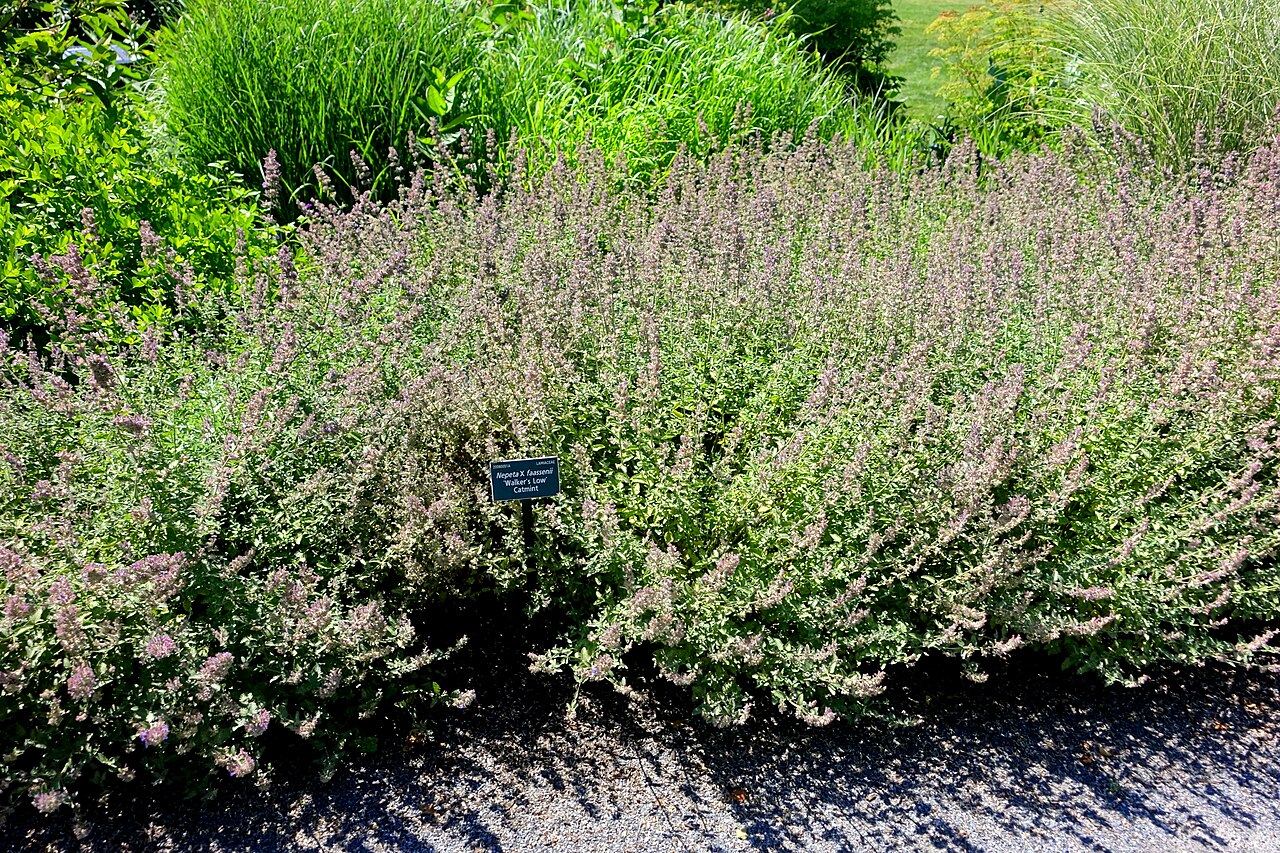
Catmint is one of the hardest-working perennials you can plant. From late spring into fall it produces clouds of small lavender-blue flowers over mounds of soft, gray-green, aromatic leaves, and it keeps going through heat and drought that stop many other plants. Bees swarm it, deer and rabbits avoid it, and a quick shearing after the first flush of bloom brings another round of flowers weeks later.
Catmint is a close relative of catnip, and some cats do enjoy rolling in it, though usually far less than in true catnip. It suits almost any sunny spot, from the front of a border to a dry slope, a rock wall or the edge of a path. It asks for little beyond sun and soil that drains, and most problems come from wet soil or too much care.
How Do You Grow Catmint?
Grow catmint (Nepeta) in full sun and well-drained soil in USDA zones 3 to 8, spacing plants 18 to 24 inches apart or more for large varieties. Water only until established and skip fertilizer, which causes floppy growth. After the first flush of flowers fades in early summer, cut the plants back by about half to encourage fresh foliage and a second round of bloom into fall.
| Botanical name | Nepeta × faassenii, Nepeta racemosa and hybrids |
|---|---|
| Common names | Catmint, nepeta |
| USDA zones | 3 to 8 |
| Sun | Full sun; tolerates light shade |
| Height | 1 to 3 feet, depending on variety |
| Spread | 2 to 4 feet |
| Bloom time | Late spring through summer into early fall, with rebloom after shearing |
| Grown for | Both flowers and foliage |
| Flower color | Lavender-blue, violet, pink, white |
| Soil moisture | Dry to average, well drained |
| Deer | Resistant |
| Drought tolerance | High once established |
| Native range | Europe, Asia and North Africa |
| Pet toxicity | Not listed by the ASPCA; its close relative catnip is listed as toxic to cats, causing vomiting or diarrhea |
| Maintenance | Low |
Catmint vs. Catnip
Catmint and catnip belong to the same genus, Nepeta, which includes about 250 species in the mint family. Catnip is Nepeta cataria, a weedy, upright plant with fuzzy green leaves and small white flowers spotted with pale purple, grown mainly for cats. It contains high levels of nepetalactone, the compound that makes many cats roll, rub and play.
Catmint is the name used for the ornamental species and hybrids grown for their long display of blue flowers, mainly Nepeta × faassenii and Nepeta racemosa. They contain less nepetalactone, so most cats show only mild interest, although some will still roll in young plants. If cats flatten new plantings, protect them with a wire cage until they grow larger.
Types of Catmint
Most catmint sold in garden centers comes from a few species and their hybrids, which differ in height, flower size and how they respond to pruning.
Nepeta × faassenii
This is the classic garden catmint, a hybrid of Nepeta racemosa and Nepeta nepetella named after the Dutch nurseryman J. H. Faassen. It forms soft, spreading mounds of small gray-green leaves covered in small lavender-blue flowers. Most plants are sterile and do not set seed. ‘Walker’s Low’ and ‘Six Hills Giant’ belong to this group.
Nepeta racemosa
Also sold as Nepeta mussinii, this species from the Caucasus and Iran has slightly larger, purple-blue flowers on compact, self-supporting plants. It can set seed and self-sow in some gardens. ‘Walker’s Low’ is sometimes listed under this species.
Other Catmints
Siberian catmint (Nepeta sibirica) grows taller, with larger flowers and green leaves, and blooms in early to midsummer. Japanese catmint (Nepeta subsessilis) has large flowers and green leaves and tolerates more shade and moisture than most. Nepeta grandiflora includes tall varieties such as ‘Dawn to Dusk’, with pink flowers. These larger-flowered types generally need deadheading or shearing after bloom to look their best.
Where Catmint Grows Best
Most catmints are hardy in USDA zones 3 through 8 and handle summer heat well, though they may flop or stop blooming in the hottest, most humid parts of the South. In an eight-year trial of 36 catmints at the Chicago Botanic Garden, the plants proved reliably winter hardy. The losses that did occur were caused by wet soil and poor drainage in winter, not by cold.
Give catmint full sun for the most flowers and the tightest habit. It tolerates light shade, especially in hot climates, but in too much shade the stems stretch and fall open and the plants bloom less. Japanese catmint is the best choice for part shade.
Catmint grows in almost any well-drained soil, from sandy and gravelly ground to average garden loam, and tolerates poor, dry soil and a wide pH range. Its only real enemy is soil that stays wet, especially over winter. On heavy clay, plant it on a slope, a raised bed or the top of a wall. Rich soil and fertilizer make the stems long, soft and floppy.
How to Plant Catmint
Plant catmint in spring after the last frost or in early fall at least six weeks before the ground freezes. Dig a hole as deep as the pot and about twice as wide, set the plant so the top of the root ball is level with the soil surface and backfill with the native soil. Water well after planting.
Catmint spreads wider than many gardeners expect. Space compact varieties about 18 inches apart and large ones such as ‘Six Hills Giant’ and ‘Walker’s Low’ 2 to 3 feet apart. Mulch lightly with shredded bark or gravel, keeping it away from the crown.
Watering and Feeding
Water new plants about once a week through their first season if rain is scarce. Once established, catmint rarely needs extra water and is one of the most drought-tolerant perennials for sunny borders. In very long droughts, a deep watering keeps it blooming.
Catmint needs no fertilizer. The Chicago Botanic Garden trial found that feeding catmint makes the stems floppy. Average or even poor soil gives the best results.
Pruning and Shearing Catmint
Pruning keeps catmint compact and blooming. The main job is a shearing after the first big flush of flowers, usually in early to midsummer, when the flowers fade and the plant starts to look open or tired. Cut the whole plant back by about half with hedge shears. Within a few weeks it produces fresh, tidy foliage and a second round of flowers that often lasts into fall.
Some catmints, including ‘Walker’s Low’ and similar gray-leaved types, rebloom on their own as new shoots grow up through the old flowers, and they keep blooming without deadheading. Shearing still tidies them and makes the second bloom heavier. Large-flowered types such as Siberian and Japanese catmint need shearing or deadheading after bloom to look good.
In fall, you can leave the stems standing over winter or cut them back after a hard frost. Either way, cut back any remaining dead stems in early spring just as new growth appears at the base. A light trim of the new growth in spring also keeps tall varieties more compact.
Dividing and Propagating Catmint
Catmint does not need frequent division. Divide clumps every four to five years in spring, or sooner if the center opens up and dies out. Dig up the clump, cut it into sections with healthy shoots and roots, and replant at the same depth.
Catmint is also easy to grow from cuttings. Take 3- to 4-inch stem tips in late spring or early summer, remove the lower leaves and root them in moist potting mix. Because most Nepeta × faassenii varieties are sterile, cuttings and division are the only way to propagate them.
Best Catmint Varieties
The Chicago Botanic Garden trial, which ran from 1999 to 2006, gave its top rating to four catmints: ‘Joanna Reed’, ‘Six Hills Giant’, ‘Select Blue’ and ‘Walker’s Low’. These and a few other favorites are reliable choices.
‘Walker’s Low’
The most popular catmint, named Perennial Plant of the Year in 2007 by the Perennial Plant Association. Despite the name, it is not especially low; its arching stems reach 2 to 3 feet, forming a mound about 30 inches tall and 3 feet wide covered in lavender-blue flowers from late spring into fall.
‘Six Hills Giant’
A large, vigorous catmint about 30 inches tall and 4 feet wide, with lavender-blue flowers. It makes a bold edging or low hedge and fills space quickly.
‘Joanna Reed’
A top-rated catmint about 2 feet tall and 4 feet wide, with lavender-blue flowers on a broad, spreading mound. It is excellent for covering slopes and large beds.
‘Select Blue’
A compact catmint about 14 inches tall and 30 inches wide, with lavender flowers set off by dark calyces. It suits smaller gardens, edging and the front of a border.
‘Cat’s Pajamas’
A newer compact catmint about 12 to 14 inches tall with dark indigo-blue flowers on a tidy, upright mound. It is a good choice for containers and small spaces.
‘Dawn to Dusk’
A tall Nepeta grandiflora variety, 2 to 3 feet tall, with soft pink flowers and gray-green leaves. It is one of the few pink catmints and blooms in early to midsummer.
Catmint for Pollinators
Catmint is one of the best perennials for bees. Honeybees, bumblebees and many small native bees visit its flowers from late spring to fall, and butterflies also feed on it. Because it reblooms after shearing, it provides nectar through the gaps between other plants’ bloom times. Shearing half of a large planting at a time keeps some flowers open for pollinators while the other half regrows.
Companion Plants for Catmint
Catmint’s soft blue flowers and gray foliage combine with almost anything. It is a classic partner for roses, softening their bare lower stems and hiding the ground beneath them. Yellow and gold flowers such as black-eyed Susan, yarrow, coreopsis and daylilies make a strong contrast. Salvia, lavender, Russian sage and alliums create a cool blue and purple planting, while ornamental grasses and sedum extend the season into fall. Catmint also makes an excellent edging along paths and in front of taller perennials.
Common Catmint Problems
Catmint has few pests or diseases, and deer and rabbits leave it alone because of its strong scent. Problems usually come from growing conditions.
Flopping and Splitting
Catmint that falls open in the center is usually growing in rich or wet soil, in too much shade or has not been cut back after flowering. Shear it back by half after the first bloom, stop fertilizing, and move it to a sunnier, leaner spot if the problem continues. Some varieties naturally spread open as new stems push outward; the second flush fills them back in.
Crown Rot
Wet soil, especially in winter, rots the crown, and plants may fail to return in spring. Grow catmint only in well-drained soil and avoid heavy mulch against the crown.
Leaf Spot and Powdery Mildew
Leaf spot and powdery mildew occasionally appear in humid weather on crowded plants. Shearing after bloom removes affected growth, and good spacing prevents most problems.
Cats
Some cats roll in and flatten catmint, especially young plants. A small wire cage over new plants protects them until they are established.
Growing Catmint in Containers
Compact catmints such as ‘Cat’s Pajamas’ and ‘Select Blue’ grow well in containers at least 12 to 14 inches wide, where they spill over the edges. Use a well-draining potting mix and a pot with drainage holes, place it in full sun and water when the top inch of mix is dry. In zones colder than 5, move pots to a sheltered spot or unheated garage for winter.
Frequently Asked Questions
These are the questions gardeners ask most about catmint.
Is Catmint the Same as Catnip?
No. Both are in the genus Nepeta, but catnip is Nepeta cataria, a weedy herb that strongly attracts cats. Catmint refers to ornamental species and hybrids grown for their blue flowers, which attract cats much less.
Should You Cut Back Catmint after Flowering?
Yes. Cutting catmint back by about half after the first flush of flowers fades keeps it compact and brings a second round of bloom that often lasts into fall.
Does Catmint Spread?
Catmint forms wide clumps, 2 to 4 feet across, but most popular varieties are sterile and do not spread by seed or runners. Nepeta racemosa and some other types can self-sow.
Is Catmint Deer Resistant?
Yes. Catmint’s strongly scented leaves make it one of the most reliable deer- and rabbit-resistant perennials.
Is Catmint Safe for Cats?
Catmint is generally safe for cats to roll in and sniff. The ASPCA notes that the related catnip can cause vomiting and diarrhea if cats eat a lot of it, so keep an eye on cats that chew the plants heavily.
Sources
- A Comparative Study of Cultivated Catmints, Chicago Botanic Garden
- Walker’s Low Catmint, University of Wisconsin–Madison Division of Extension
- Catnip, Nepeta cataria, University of Wisconsin–Madison Division of Extension
- Catnip, ASPCA Toxic and Non-Toxic Plants List