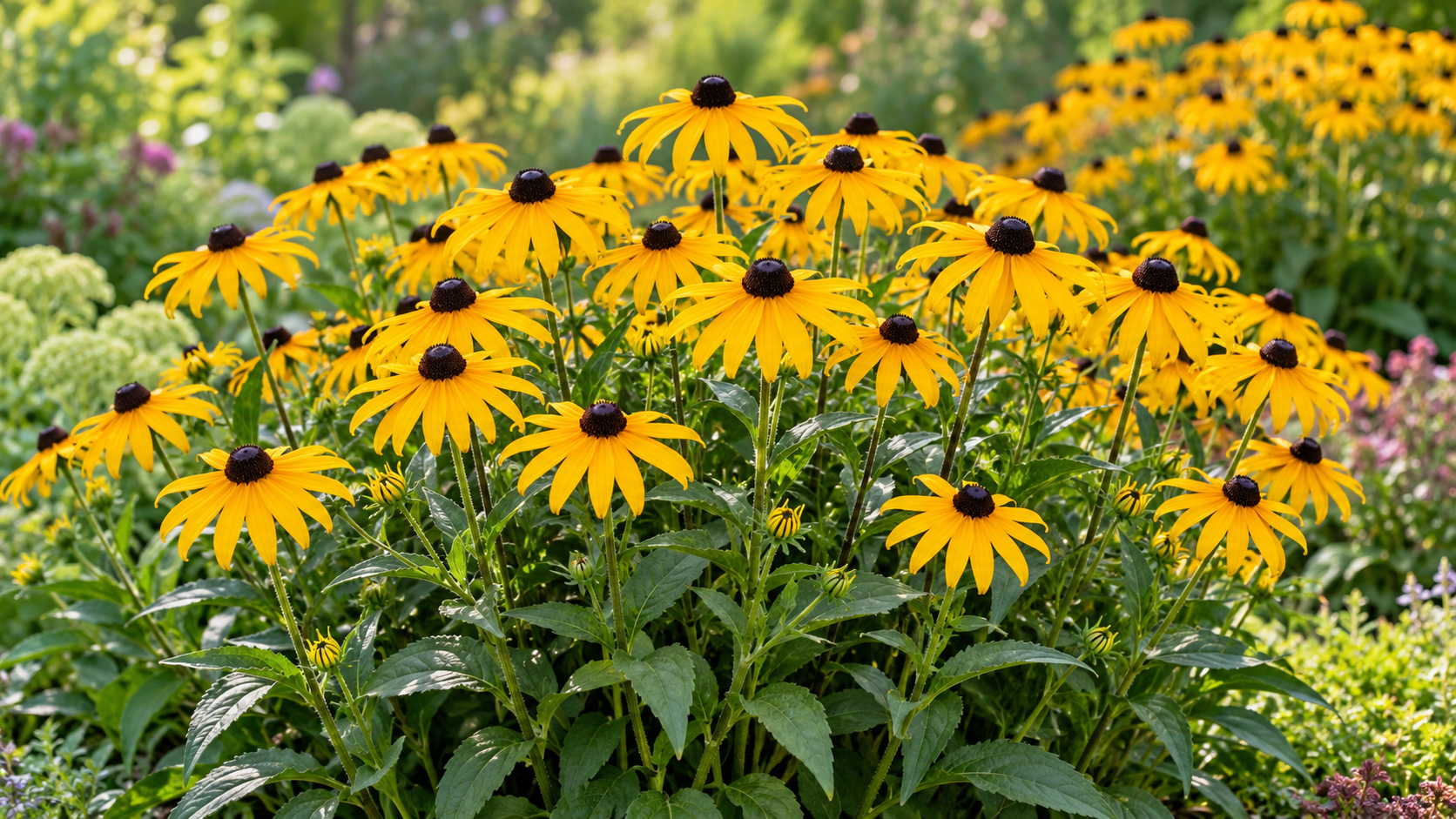
Black-eyed Susans are the cheerful backbone of the late-summer garden. Their golden yellow petals around a dark brown, domed center light up borders, meadows and roadsides from midsummer until frost, long after many perennials have finished. Native to much of North America, they handle heat, drought, clay and poor soil, attract bees and butterflies, and feed goldfinches with their seeds in fall. Maryland made the black-eyed Susan its state flower in 1918, and it has been a garden favorite ever since.
The one thing that confuses many gardeners is that “black-eyed Susan” covers several different plants in the genus Rudbeckia. Some are long-lived perennials that spread into generous clumps. Others live only a year or two and keep going by reseeding. Knowing which one you have explains most of what happens in your garden, including why some plants seem to disappear.
How Do You Grow Black-Eyed Susans?
Grow black-eyed Susans (Rudbeckia) in full sun and well-drained soil in USDA zones 3 to 9, spacing plants 18 to 24 inches apart. They bloom from midsummer to fall and need little water or fertilizer once established. Rudbeckia fulgida, such as ‘Goldsturm’, is a long-lived perennial; Rudbeckia hirta is short lived and returns mainly by reseeding.
| Botanical name | Rudbeckia spp. |
|---|---|
| Common names | Black-eyed Susan, orange coneflower, rudbeckia |
| USDA zones | 3 to 9 |
| Sun | Full sun to light part shade, at least 6 hours of direct sun |
| Height | 1.5 to 3 feet for most garden types |
| Spread | 1.5 to 2.5 feet |
| Bloom time | Midsummer to fall |
| Grown for | Flowers |
| Flower color | Golden yellow, orange, bronze, red, bicolor |
| Soil moisture | Dry to average, well drained |
| Deer | Resistant |
| Drought tolerance | High once established |
| Native range | Much of North America |
| Pet toxicity | Not considered toxic to dogs, cats or horses; rough leaves can irritate skin |
| Maintenance | Low |
Types of Black-Eyed Susans
The genus Rudbeckia includes about two dozen species, all native to North America. Two of them account for nearly all the black-eyed Susans in gardens, and they behave very differently.
Orange Coneflower (Rudbeckia fulgida)
This is the long-lived perennial black-eyed Susan. It forms a spreading clump 2 to 3 feet tall with dark green leaves and a heavy crop of golden flowers from midsummer into fall. It spreads slowly by short underground stems and by seed to form a solid mass over a few years. The most popular variety, ‘Goldsturm’, is a form of this species, and it is the type to choose if you want a plant that comes back reliably year after year.
Common Black-Eyed Susan (Rudbeckia hirta)
Rudbeckia hirta is the wildflower of meadows and roadsides and the source of most seed-grown garden varieties. It is an annual, biennial or short-lived perennial, usually lasting only one to three years. It has hairy, rough leaves and stems and often larger flowers than fulgida, including bronze, red and bicolor forms. It survives in gardens by reseeding, so a planting can persist for years even though individual plants do not.
Other Rudbeckias
Brown-eyed Susan (Rudbeckia triloba) is a bushy, short-lived plant covered in small flowers in late summer. Sweet coneflower (Rudbeckia subtomentosa) grows 4 to 5 feet tall with fragrant foliage; its variety ‘Henry Eilers’ has distinctive quilled petals. Cutleaf coneflower (Rudbeckia laciniata) and giant coneflower (Rudbeckia maxima) can reach 6 feet or more and suit the back of a border or a wild garden.
Where Black-Eyed Susans Grow Best
Black-eyed Susans grow in USDA zones 3 through 9, covering nearly all of the United States and southern Canada. They are at their best in open, sunny spots where many perennials struggle with heat.
Give them full sun, at least 6 hours of direct light a day. They tolerate light shade, but in too much shade the stems stretch and flop and the plants flower less. Good air circulation reduces leaf spot and powdery mildew, the two most common diseases, so avoid crowding them.
They adapt to almost any soil, including clay and sandy soil, as long as it drains. Average soil is ideal; very rich soil produces tall, floppy growth. A pH of about 6.0 to 7.0 suits them. Once established, they tolerate drought well, although Rudbeckia fulgida appreciates a little more moisture than hirta in hot, dry summers.
How to Plant Black-Eyed Susans
Plant potted black-eyed Susans in spring after the last frost or in early fall at least six weeks before the ground freezes. Dig a hole as deep as the pot and about twice as wide, and set the plant so the top of the root ball is level with the soil surface. Backfill with the native soil, firm it gently and water thoroughly.
Space plants 18 to 24 inches apart. Rudbeckia fulgida will fill the gaps within two or three years, while hirta plants stay as individual clumps. A 2-inch layer of shredded bark or leaf mulch helps hold moisture and suppress weeds; keep it pulled back from the base of the stems.
Growing Black-Eyed Susans from Seed
Black-eyed Susans are among the easiest perennials to grow from seed. Rudbeckia hirta germinates readily without special treatment. Start it indoors 6 to 8 weeks before your last frost, pressing the seed onto the surface of the mix and covering it only lightly, since light helps germination. Many hirta varieties bloom the first summer from an early start. Rudbeckia fulgida germinates better after about 30 days of cold, moist conditions, so sow it outdoors in fall or refrigerate the seed in damp sand before starting it indoors. It usually blooms in its second year.
Watering and Feeding
Water new plants about once a week through their first season, soaking the root zone deeply. Established black-eyed Susans rarely need extra water except during long droughts. Water at the base in the morning rather than over the leaves, which helps prevent leaf spot.
Black-eyed Susans need no fertilizer in average garden soil. Extra nitrogen produces leafy, floppy plants with fewer flowers. A thin layer of compost in spring is all they need in poor soil.
Deadheading, Cutting Back and Winter Care
Deadheading spent flowers during summer encourages more blooms and extends the season, especially on Rudbeckia hirta. Cut faded flowers back to a leaf or side bud. Stop deadheading by late summer if you want plants to reseed or want to leave food for birds; goldfinches and other seed-eating birds visit the dark seed heads through fall and winter.
Leave the stems standing over winter for birds, insects and winter interest, then cut them back to a few inches in early spring before new growth appears. The one exception is foliage badly affected by leaf spot, which is better cut and removed in fall to reduce disease the following year.
Cutting Black-Eyed Susans for the Vase
Black-eyed Susans make excellent cut flowers and often last a week or more in the vase. Cut them when the petals are fully open, early in the morning, and put the stems in water immediately. Cutting also encourages the plant to produce more flowers.
Dividing and Spreading
Rudbeckia fulgida clumps become crowded after a few years, with a thinning, less floriferous center. Divide them every three to four years in spring as new growth emerges or in early fall. Lift the clump, pull or cut it into sections with several shoots and roots each, and replant at the same depth. The outer, younger sections make the best divisions.
Rudbeckia hirta is not divided, since individual plants are short lived. Instead, let some flowers set seed in late summer and thin the seedlings the following spring. If a planting is spreading more than you want, deadhead before the seeds ripen and pull unwanted seedlings while they are small.
Best Black-Eyed Susan Varieties
These varieties are proven performers. Choose fulgida types for long-lived perennial clumps, and hirta types for big flowers, unusual colors and quick results from seed.
‘Goldsturm’
The best-known black-eyed Susan, ‘Goldsturm’ was introduced in Germany in 1937 by the nurseryman Karl Foerster and was named Perennial Plant of the Year in 1999 by the Perennial Plant Association. It forms dense clumps about 2 feet tall covered in golden flowers from midsummer to fall. Its main weakness is Septoria leaf spot in humid summers.
‘American Gold Rush’
A newer perennial variety bred for strong resistance to Septoria leaf spot, with narrow, hairy leaves and a compact, rounded habit about 2 feet tall. It is a good alternative to ‘Goldsturm’ where leaf spot is a problem.
‘Little Goldstar’
A compact fulgida variety about 14 to 16 inches tall and covered in small golden flowers. Its tidy size suits the front of borders and containers.
‘Indian Summer’
An All-America Selections winner with very large golden flowers, often 6 to 9 inches across, on plants 3 to 4 feet tall. It is a hirta type that blooms the first year from seed and is excellent for cutting.
‘Cherokee Sunset’
Another All-America Selections winner, ‘Cherokee Sunset’ produces double and semi-double flowers in shades of yellow, orange, bronze and mahogany. It is a hirta type about 2 feet tall.
‘Henry Eilers’
A selection of sweet coneflower with narrow, rolled, quill-like petals that give the flowers a starry look. It grows 4 to 5 feet tall, blooms late in the season and is long lived.
Companion Plants for Black-Eyed Susans
Black-eyed Susans pair naturally with other sun-loving prairie plants. Purple coneflower blooms at the same time and shares the same easy needs, making one of the classic summer combinations. Ornamental grasses such as little bluestem, switchgrass and feather reed grass add fine texture and movement. Russian sage, catmint, blue salvia and asters provide cool blue and purple contrast. Sedum, blazing star and goldenrod extend the season into fall. For a relaxed meadow look, plant black-eyed Susans in drifts rather than single clumps.
Why Black-Eyed Susans Don’t Come Back
Black-eyed Susans that disappear after a year or two are usually Rudbeckia hirta, which is naturally short lived. Many garden center varieties, especially the large-flowered and bicolor types, are hirta, and they are sold alongside perennials without much explanation. They are not dying from something you did; they have simply completed their life cycle. Let some flowers go to seed each year to keep them coming back.
If long-lived Rudbeckia fulgida fails to return, the usual causes are soil that stays wet in winter, which rots the crowns, and severe leaf spot that weakens plants over several seasons. Improve drainage, give plants room for air to circulate, and replace heavily diseased clumps with a resistant variety such as ‘American Gold Rush’.
Common Black-Eyed Susan Problems
Black-eyed Susans are tough, deer-resistant plants with few serious problems. These are the ones gardeners see most often.
Septoria Leaf Spot
Septoria leaf spot causes small dark brown spots on the lower leaves that spread upward through the plant, eventually turning the foliage black. It is the most common problem on ‘Goldsturm’ and is worst in wet, humid summers. The plant usually keeps flowering, but it looks ragged. Water at the base, space plants for air circulation, remove badly spotted leaves and clean up infected foliage in fall. Resistant varieties are the best long-term fix.
Powdery Mildew
A white, powdery coating on the leaves appears in late summer, especially on crowded plants. It is mostly cosmetic. Thin crowded clumps and avoid overhead watering.
Aster Yellows
Aster yellows, the same disease that affects coneflowers, causes distorted flowers with green, leafy growth sprouting from the center. It is spread by leafhoppers and has no cure. Remove and destroy infected plants promptly.
Slugs, Snails and Rabbits
Slugs and snails chew young leaves and seedlings in spring, and rabbits sometimes eat new shoots. Deer usually avoid black-eyed Susans because of their rough, hairy leaves. Protect young plants with a ring of chicken wire until they are established.
Growing Black-Eyed Susans in Containers
Compact varieties such as ‘Little Goldstar’ and short hirta types grow well in containers at least 12 inches wide and deep. Use a well-draining potting mix and a pot with drainage holes, and water when the top inch of mix is dry. Deadhead regularly to keep container plants blooming. In zones colder than 6, move pots of perennial types to a sheltered spot or an unheated garage for winter.
Frequently Asked Questions
These are the questions gardeners ask most about black-eyed Susans.
Are Black-Eyed Susans Perennials?
Some are. Rudbeckia fulgida, including ‘Goldsturm’, is a true long-lived perennial. Rudbeckia hirta, the source of most large-flowered and colorful seed varieties, is an annual, biennial or short-lived perennial that returns mainly by reseeding.
Do Black-Eyed Susans Spread?
Rudbeckia fulgida spreads slowly by underground stems and seed to form a wide clump, and both fulgida and hirta reseed readily. They are easy to control by deadheading before seeds ripen and pulling unwanted seedlings in spring.
What Is the Difference between Black-Eyed Susan and Coneflower?
Both are North American members of the daisy family, but black-eyed Susans (Rudbeckia) usually have yellow or orange petals and a dark brown, rounded center, while coneflowers (Echinacea) are usually purple-pink with a spiky, orange-brown cone. Black-eyed Susans have softer centers and hairier leaves.
Should You Deadhead Black-Eyed Susans?
Deadheading during summer encourages more flowers, especially on hirta types. Stop by late summer if you want plants to reseed or want to leave seed heads for birds over winter.
When Do Black-Eyed Susans Bloom?
Most black-eyed Susans bloom from midsummer into fall, typically from July through September or October. Hirta types started early from seed can begin flowering in early summer.