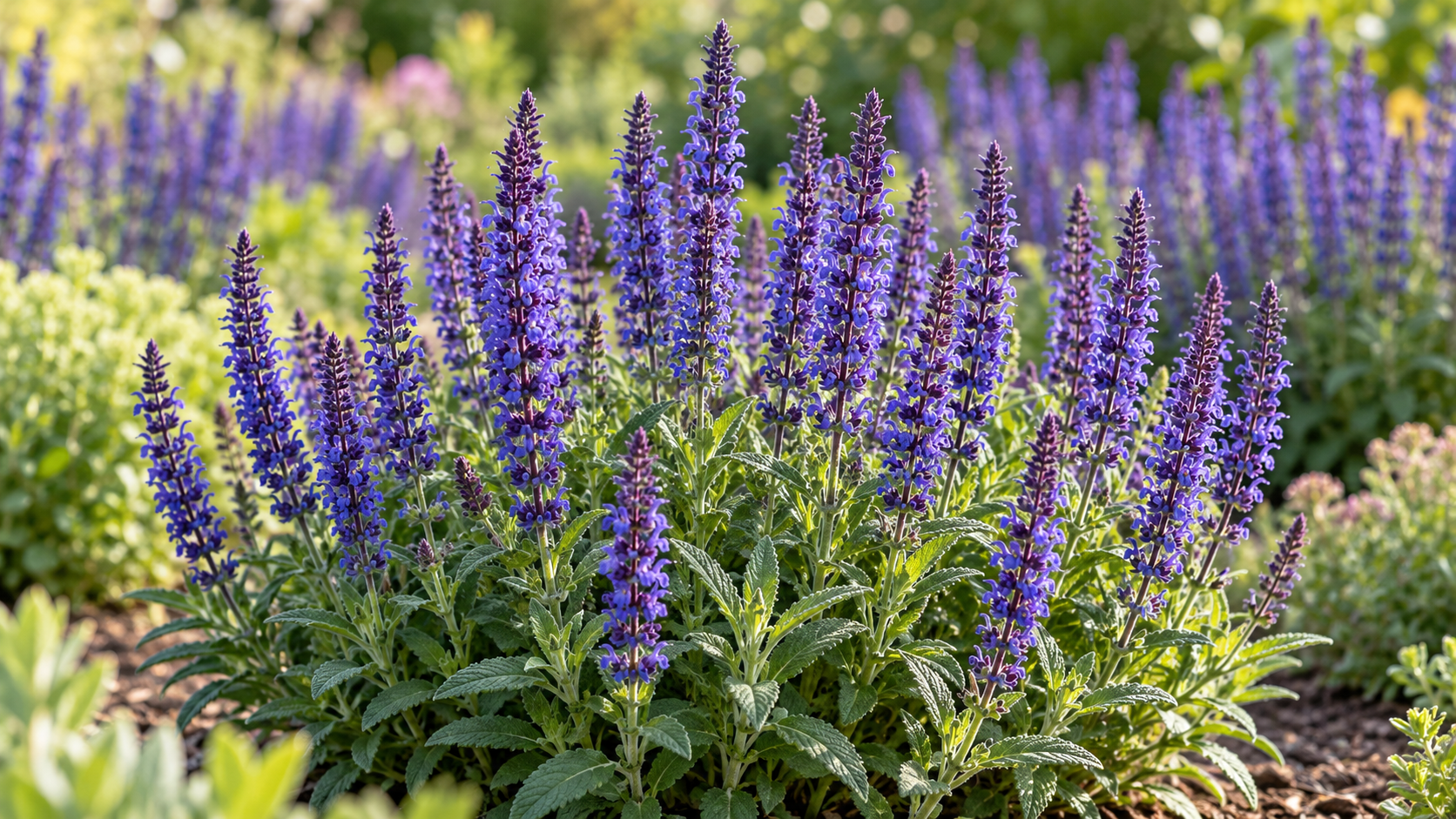
Perennial salvia is one of the most useful plants in the sunny border. Its upright spikes of violet, blue, pink or white flowers open in late spring, just as the early bulbs fade, and with a quick trim after the first flush they keep coming back in waves until fall. Bees and butterflies work the flowers from morning to evening, and hummingbirds visit the red and tubular types. The aromatic, slightly fuzzy leaves discourage deer and rabbits, and established plants shrug off heat and drought.
Salvia is also a huge and confusing genus. With roughly 1,000 species, it is the largest group in the mint family, and it includes culinary sage, tender annual bedding plants and tough, cold-hardy perennials. This guide focuses on the hardy perennial salvias most gardeners grow, with notes on the other types you will see at the garden center.
Quick Answer
Grow perennial salvia (Salvia nemorosa and its hybrids) in full sun and well-drained soil in USDA zones 4 to 8, spacing plants 18 to 24 inches apart. It blooms from late spring into early summer. Cut the flower stems back by about half when the first flush fades, and it will rebloom from midsummer into fall. Water only during long dry spells once established.
| Botanical name | Salvia nemorosa and hybrids |
|---|---|
| Common names | Salvia, perennial sage, meadow sage, woodland sage |
| USDA zones | 4 to 8 (hardy perennial salvia) |
| Sun | Full sun, at least 6 hours of direct sun |
| Height | 1 to 3 feet, depending on variety |
| Spread | 1.5 to 2 feet |
| Bloom time | Late spring to early summer, with repeat bloom from midsummer into fall when cut back |
| Grown for | Flowers |
| Flower color | Violet, blue, purple, pink, white, red |
| Soil moisture | Dry to average, well drained |
| Deer | Resistant |
| Drought tolerance | High once established |
| Native range | Europe and western Asia (Salvia nemorosa) |
| Pet toxicity | Not considered toxic to dogs, cats or horses |
| Maintenance | Low |
Types of Salvia
Salvias fall into a few broad groups that differ mainly in hardiness. Knowing which group a plant belongs to tells you whether it will survive your winter and how to prune it.
Hardy Perennial Salvia
Salvia nemorosa and the closely related hybrids sold as Salvia × sylvestris and Salvia × superba are the perennial salvias of cold-climate gardens. They form low clumps of gray-green leaves with dense spikes of small flowers on 1- to 3-foot stems, and they are reliably hardy in zones 4 to 8. Most named varieties such as ‘May Night’ and ‘Caradonna’ belong here. Meadow clary (Salvia pratensis) is a similar hardy species with larger, more open flowers.
Shrubby and Southern Salvias
Autumn sage (Salvia greggii) and its hybrids are small, woody shrubs with red, pink, coral or bicolor flowers from late spring to frost. They are hardy to about zone 6 or 7 and thrive in hot, dry climates. Anise-scented sage (Salvia guaranitica) grows 3 to 5 feet tall with deep blue, tubular flowers loved by hummingbirds and is hardy to about zone 7.
Annual Salvias
Scarlet sage (Salvia splendens) and mealycup sage (Salvia farinacea) are tender plants grown as annuals in most of North America. They bloom all summer but do not survive frost. Many popular hybrids, such as ‘Amistad’, are hardy only in mild climates and are treated as annuals farther north.
Culinary Sage and Russian Sage
Common sage (Salvia officinalis), the kitchen herb, is a woody perennial hardy in zones 5 to 8 with gray, pebbly leaves and blue-purple flowers. Russian sage, long known as Perovskia, was moved into the genus Salvia in 2017 and is now Salvia yangii, although most nurseries still sell it under its old name.
Where Salvia Grows Best
Hardy perennial salvia grows in USDA zones 4 through 8. It handles cold winters well as long as the soil drains, and it tolerates summer heat, although in the hottest parts of zone 8 it appreciates a little afternoon shade.
Give salvia full sun, at least 6 hours of direct light a day. In shade, the stems stretch, the clump splays open and the plant blooms poorly. Good air circulation helps prevent powdery mildew.
Salvia prefers average, well-drained soil and does fine in sandy, rocky or even fairly lean soil. It tolerates clay if water does not stand around the crown, but wet winter soil is the most common reason plants fail to return. Very rich soil produces soft, floppy growth. A pH of about 6.0 to 7.5 is ideal.
How to Plant Salvia
Plant perennial salvia in spring after the last frost or in early fall at least six weeks before the ground freezes. Spring planting is safer in zones 4 and 5, since it gives the roots a full season to establish.
Dig a hole as deep as the pot and about twice as wide. Set the plant so the top of the root ball is level with the surrounding soil, backfill with the native soil and firm it gently. Water thoroughly after planting. Space compact varieties about 18 inches apart and larger ones up to 24 inches apart. A thin layer of fine bark or gravel mulch helps hold moisture and suppress weeds; keep it away from the crown.
Watering and Feeding
Water new plants about once a week through their first growing season. Once established, perennial salvia is quite drought tolerant and needs extra water only during extended dry spells. Water at the base of the plant rather than over the foliage.
Salvia needs little or no fertilizer. A thin layer of compost in spring is enough in most gardens. Too much nitrogen leads to lush, weak stems that flop open and fewer flowers.
Deadheading and Cutting Back for Rebloom
Cutting back is the secret to getting months of flowers from perennial salvia. When most of the first flush of flowers has faded and the spikes look brown, cut the flower stems back by about half, or down to just above a pair of healthy leaves or new side shoots. Within three to four weeks, the plant will send up a fresh round of blooms. Repeat the process after the second flush for a third, lighter bloom in late summer and fall.
If a clump has flopped open in the middle, you can instead shear the whole plant back to its low mound of basal leaves after the first bloom. It will regrow neatly and flower again.
Fall and Spring Cleanup
Hardy perennial salvia can be cut back to its basal leaves in late fall after frost, or left standing through winter and cut back in early spring. Woody salvias such as autumn sage, culinary sage and Russian sage are different: do not cut them back in fall. Wait until new growth appears in spring, then trim just above the new shoots, since hard fall pruning can lead to winter dieback.
Dividing and Propagating Salvia
Perennial salvia benefits from division every three to four years, or when the center of the clump becomes woody and sparse. Divide in early spring as new growth appears. Lift the clump, cut it into sections with several shoots and a good set of roots, discard the old woody center and replant at the same depth.
Salvia also roots easily from cuttings. In late spring or early summer, take 3- to 4-inch cuttings from non-flowering shoots, remove the lower leaves and insert them in moist potting mix. Keep them in bright, indirect light, and they usually root within a few weeks. Named varieties do not come true from seed, so cuttings and division are the best ways to multiply them.
Best Salvia Varieties
These varieties are proven, hardy performers in most of North America. All are perennial in zones 4 to 8 except where noted.
‘May Night’
Also sold as ‘Mainacht’, ‘May Night’ was named Perennial Plant of the Year in 1997 by the Perennial Plant Association. It has deep indigo-violet flowers on stems about 18 to 24 inches tall and is one of the earliest and most reliable salvias to bloom.
‘Caradonna’
‘Caradonna’ has violet-blue flowers on striking, nearly black stems that stand straight up, giving it a strong vertical look. It grows about 18 to 24 inches tall and reblooms well when cut back.
‘East Friesland’
Also sold as ‘Ostfriesland’, this classic has deep purple flowers on compact plants about 18 inches tall. It is a dependable choice for edging and mass planting.
‘Blue Hill’
‘Blue Hill’, or ‘Blauhügel’, has clear, true blue flowers, closer to sky blue than most salvias. It grows about 18 inches tall and blooms over a long season.
‘Snow Hill’
The white-flowered counterpart to ‘Blue Hill’, ‘Snow Hill’ has pure white spikes on plants about 18 inches tall. It brightens mixed plantings and looks good in evening gardens.
‘Hot Lips’
An autumn sage (Salvia greggii) with small, bicolored red and white flowers that often change color with the weather. It grows 2 to 3 feet tall, blooms from late spring to frost and is a hummingbird favorite. It is hardy to about zone 7.
Companion Plants for Salvia
The spiky flowers of perennial salvia contrast nicely with rounded blooms. Roses and salvia are a classic pairing, and salvia blooms at the same time as peonies, alliums and early daylilies. Yellow flowers such as yarrow, coreopsis and black-eyed Susan make vivid partners for violet and blue salvias. Catmint, lady’s mantle and hardy geraniums soften the base of the plants, while coneflower and ornamental grasses carry the border into late summer. Repeat salvia in groups of three or more for the strongest effect.
Why Salvia Stops Blooming
Salvia that blooms once and then stops usually needs cutting back. Spent flower spikes left on the plant go to seed, and the plant slows down. Cut the stems back by about half after the first flush to trigger new flowers.
Other causes include too much shade, which reduces flowering and makes the plant sprawl; too much fertilizer, which favors leaves over flowers; and crowding, since old clumps with woody centers bloom less. Divide clumps that are more than three or four years old and move plants in shade to a sunnier spot.
Common Salvia Problems
Salvia is a tough, deer-resistant plant with few serious problems. These are the ones most gardeners run into.
Flopping
Clumps that split open in the center are usually growing in too much shade or overly rich soil, or they are simply old. Cut them back after bloom, reduce fertilizer and divide old clumps. Compact varieties are less prone to flopping.
Powdery Mildew
A white, powdery coating on the leaves appears in humid weather, especially on crowded plants. It is mostly cosmetic. Space plants for air circulation, avoid overhead watering and cut back affected foliage.
Root Rot
Plants that wilt and collapse despite moist soil usually have root rot from poor drainage. It is most common in heavy clay and in winter. Replant in a better-drained spot or a raised bed.
Four-Lined Plant Bugs and Aphids
Four-lined plant bugs leave small, round, sunken spots on the leaves in late spring and early summer. The damage is mostly cosmetic and stops once the insects mature. Aphids sometimes cluster on new growth and can be knocked off with a strong spray of water.
Growing Salvia in Containers
Compact salvias grow well in containers at least 12 inches wide and deep. Use a well-draining potting mix and a pot with drainage holes, and water when the top inch of mix is dry. Cut back spent flowers regularly to keep plants blooming. In zones colder than 6, move pots of perennial salvia to an unheated garage or sheltered spot for winter, and treat tender types as annuals or bring them indoors.
Frequently Asked Questions
These are the questions gardeners ask most about growing salvia.
Is Salvia a Perennial?
Some salvias are perennial and some are annual. Salvia nemorosa and its hybrids, such as ‘May Night’ and ‘Caradonna’, are hardy perennials in zones 4 to 8. Scarlet sage and mealycup sage are tender and grown as annuals in most of North America.
Is Salvia the Same as Sage?
Yes. Salvia is the botanical name for the sage genus, and many salvias are called sage. Culinary sage is Salvia officinalis, while ornamental perennial salvias are usually grown for their flowers rather than for cooking.
Should You Deadhead Salvia?
Yes. Cutting the flower stems back by about half after the first flush fades encourages a second and often a third round of blooms from midsummer into fall.
Is Salvia Deer Resistant?
Yes. The aromatic, slightly fuzzy leaves of most salvias discourage deer and rabbits, which makes salvia one of the more dependable deer-resistant perennials.
Does Salvia Attract Hummingbirds?
Many salvias do, especially those with red or tubular flowers such as autumn sage and anise-scented sage. The spiky violet and blue perennial salvias are also magnets for bees and butterflies.