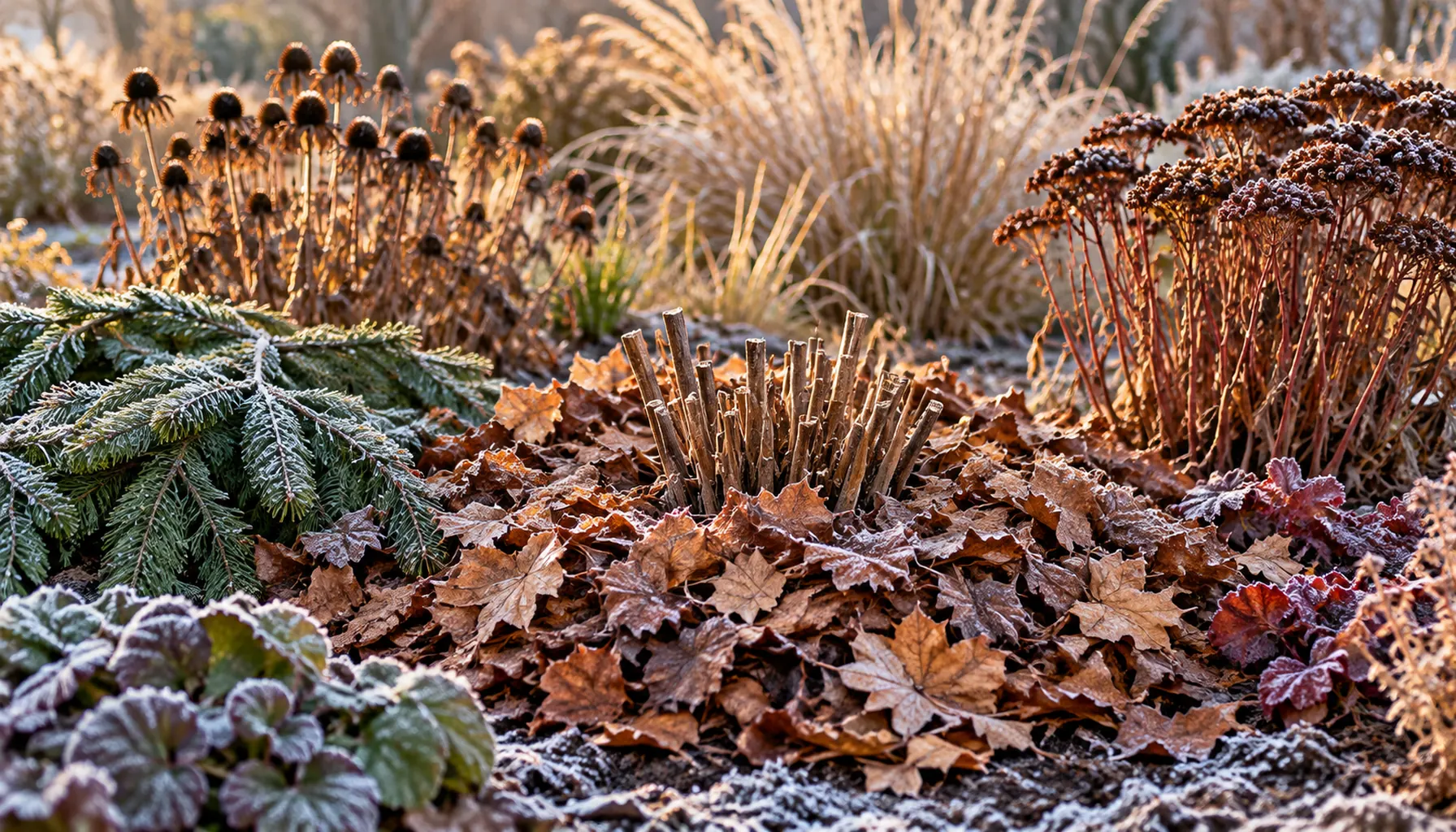
Most perennials are built for winter. Their tops die back, their roots and crowns go dormant, and they sit out the cold underground until the soil warms in spring. A plant rated for your hardiness zone does not need a blanket to survive a normal winter. Yet every spring, gardeners find gaps where healthy plants used to be.
Cold alone rarely causes those losses. Soggy soil, repeated freezing and thawing, late planting, bare ground with no snow cover and hungry voles do far more damage. Overwintering perennials well is mostly about preventing those problems, with a few simple steps in fall and a little extra protection for the plants that need it.
How Do You Overwinter Perennials?
Grow perennials rated for your USDA zone, stop fertilizing by late summer and keep watering until the ground freezes. After the top few inches of soil freeze, spread 2 to 4 inches of shredded leaves, straw or evergreen boughs over new, shallow-rooted and marginally hardy plants. Keep mulch off the crowns of evergreen perennials, move potted perennials to a sheltered spot, and pull the mulch back gradually in spring.
Why Perennials Die over Winter
Knowing what actually kills perennials in winter tells you where to put your effort. The most common causes are:
- Wet soil. Crowns and roots sitting in cold, waterlogged soil rot, which is why lavender, salvia, coral bells and many Mediterranean plants die in heavy clay even when they are rated for the zone.
- Frost heaving. When the soil freezes and thaws repeatedly, it expands and contracts, pushing shallow-rooted plants up and out of the ground, where the exposed roots dry out and freeze.
- Late planting or dividing. Plants set out less than about six weeks before the ground freezes have not grown enough new roots to anchor themselves or take up water.
- Marginal hardiness. A plant rated to exactly your zone survives most winters but can fail in an unusually cold one, especially without snow cover.
- Winter drying. Evergreen perennials keep losing water through their leaves on sunny, windy days while the ground is frozen and roots cannot replace it.
- Voles and rabbits. Voles tunnel under snow and mulch and chew crowns and roots; rabbits nibble exposed stems and evergreen leaves.
Most of these have little to do with how cold the air gets, so the steps below focus on drainage, timing and steady soil temperatures.
Know Your Hardiness Zone
The USDA Plant Hardiness Zone Map divides North America into zones based on the average coldest winter temperature, with each zone covering a 10°F range and split into “a” and “b” halves of 5°F. The current map was released in 2023, and about half of the United States shifted into a warmer half zone compared with the 2012 version.
Choosing plants rated for your zone is the single most effective way to avoid winter losses. For long-term success, many gardeners favor plants rated one zone colder than their own, which gives a margin for the occasional harsh winter. Microclimates matter too: a bed against a south-facing wall can be a half zone warmer than an open, windswept corner of the same garden.
Getting Perennials Ready in Late Summer and Fall
Winter preparation starts well before the first frost. A few changes to your routine in late summer help plants harden off and head into dormancy with strong roots.
Stop Fertilizing by Late Summer
Nitrogen fertilizer applied after about mid-August encourages soft new growth that does not have time to toughen before frost. Stop feeding perennials by late summer and let them slow down naturally as the days shorten.
Keep Watering until the Ground Freezes
Dry soil freezes deeper and faster than moist soil, and drought-stressed plants go into winter weakened. If fall is dry, keep giving perennial beds about 1 inch of water a week until the ground freezes. This matters most for newly planted perennials and evergreen types, which keep losing moisture through their leaves all winter.
Finish Planting and Dividing Early
Plant new perennials and replant divisions at least six weeks before the ground usually freezes in your area, which is early to mid-September in zones 3 and 4 and into October in zones 6 and 7. That gives the roots time to grow into the surrounding soil. Anything planted later should get a winter mulch and a check for heaving in late winter.
How to Mulch Perennials for Winter
A winter mulch is not meant to keep plants warm. Its job is to keep the soil frozen at a steady temperature, so plants are not triggered into growth by a January thaw and then damaged when the cold returns. That is why timing matters more than anything else.
Wait until the top 2 to 3 inches of soil have frozen, which in much of the northern United States and southern Canada happens in late November or December. Mulching earlier keeps the soil warm and moist, invites voles to nest right on top of your plants and can cause crowns to rot. Spread 2 to 4 inches of mulch over the root zone, or up to 6 inches of loose straw or evergreen boughs over tender and newly planted perennials.
| Mulch | Best Use | Notes |
|---|---|---|
| Shredded leaves | General winter mulch for most beds | Shred first; whole leaves mat down, hold water and smother crowns |
| Straw | Tender and newly planted perennials | Light and airy; use straw, not hay, which is full of weed seeds |
| Evergreen boughs | Evergreen perennials and shallow-rooted plants | Shade leaves from winter sun and trap snow without packing down |
| Pine needles | Plants that dislike wet crowns | Stay loose and drain quickly |
| Shredded bark | Year-round mulch around established plants | Keep it thin over crowns; better as a permanent mulch than a winter cover |
Keep mulch a few inches away from the crowns of perennials that rot easily, and never pile it against the stems of evergreen perennials. A good snow cover is the best winter mulch of all, so in reliably snowy areas many established perennials need nothing extra.
Perennials That Need Extra Winter Protection
These groups are where a winter mulch or a little extra attention pays off.
Newly Planted and Divided Perennials
Any perennial planted or divided in the current year has a smaller root system than an established plant. Give it a winter mulch once the ground freezes, and check it for frost heaving during thaws in late winter.
Marginally Hardy Perennials
Plants at the cold edge of their range, such as lavender in zone 5, butterfly bush, anise hyssop, gaura and some ornamental salvias, are more likely to die from wet soil than from cold. Plant them in well-drained, sunny spots or raised beds, skip the fall cutback and leave the old stems as protection. Loose evergreen boughs over the top help, while a heavy, wet mulch can do more harm than good.
Evergreen Perennials
Coral bells, hellebores, bergenia, dianthus, creeping phlox and candytuft keep their leaves through winter. In open, sunny spots, winter sun and wind can scorch them, a problem known as winter burn. Evergreen boughs laid over the plants provide shade and trap snow. Do not cut the foliage in fall; tidy up damaged leaves in spring instead.
Shallow-Rooted Perennials
Coral bells, foamflower, garden mums, creeping phlox and young divisions of many perennials are the most likely to heave out of the ground. A winter mulch that keeps the soil frozen is the best prevention. Walk the beds during thaws in late winter and gently press any lifted plants back into the soil with your foot.
Perennials That Need No Winter Care
Many of the most popular perennials are hardy to zone 3 and need nothing more than a fall cleanup. Peonies, hostas, daylilies, coneflowers, black-eyed Susans, Siberian iris, catmint, sedum and most ornamental grasses survive winter in the ground across most of North America without mulch. Peonies actually need a cold winter to bloom well. Give these a winter mulch only in their first year, or if you garden in a zone at the very edge of their range.
What to Do for Each Type of Perennial
This table summarizes winter care for the main groups of perennials.
| Type | Examples | Winter Care |
|---|---|---|
| Hardy, established | Peony, hosta, daylily, coneflower, Siberian iris | Fall cleanup only; no mulch needed |
| Newly planted or divided | Any perennial planted this year | Winter mulch after the ground freezes; check for heaving |
| Marginally hardy | Lavender in zone 5, butterfly bush, gaura | Good drainage, no fall cutback, evergreen boughs |
| Evergreen | Coral bells, hellebore, bergenia, dianthus | No fall cutback; evergreen boughs for shade |
| Shallow-rooted | Coral bells, foamflower, garden mums | Winter mulch; press heaved plants back in |
| In containers | Any perennial in a pot | Sheltered spot, insulation, water when dry |
| Tender perennials | Dahlia, canna, geranium, coleus | Dig or bring indoors before frost |
Overwintering Perennials in Containers
Roots in a pot are exposed to cold from every side, so they freeze much harder than roots in the ground. A common rule of thumb is that a perennial left in a container above ground needs to be rated about two zones colder than your own to survive. A zone 3 plant, for example, is a safe choice for pots in zone 5.
For perennials that are not that hardy, you have several options. Sink the pot into the ground in a vegetable bed or empty corner and mulch over it after the soil freezes. Group pots together against a north- or east-facing wall, out of the wind and away from winter sun, and pack shredded leaves or straw around and between them. Or move them into an unheated garage or shed that stays cold but mostly above about 20°F, so the plants stay dormant without the roots freezing solid.
Potted perennials still need some water in winter. Check them once a month and water when the mix is dry and not frozen. Use frost-resistant pots made of plastic, fiberglass or high-fired ceramic, since terra cotta often cracks when wet soil freezes inside it.
Bringing Tender Perennials Indoors
Some plants that are perennial in warm climates are grown as annuals in colder zones, but you can keep them from year to year. Dahlias, cannas and gladiolus are dug after the first frost blackens the foliage. Cut the stems back to a few inches, let the tubers or rhizomes dry for a few days, then store them in slightly damp peat moss, vermiculite or wood shavings at about 40 to 50°F.
Geraniums, coleus, begonias and many salvias can be brought inside as houseplants before night temperatures drop below about 50°F. Check them for insects first, cut them back by about a third and give them the sunniest window you have. Geraniums can also be stored bare-root in a cool basement and replanted in spring.
Protecting Perennials from Voles and Rabbits
Voles are small rodents that tunnel under snow and mulch in winter and feed on crowns, roots and bulbs. The damage often goes unnoticed until spring, when plants fail to appear or lift out of the ground with no roots. Waiting until the ground freezes before mulching gives voles less time to settle in, and keeping mulch thin and away from crowns removes their cover. For prized plants, a collar of hardware cloth around the crown discourages them.
Rabbits nibble exposed stems and evergreen leaves when other food is scarce; a low fence of chicken wire around vulnerable plants keeps them off.
Overwintering Perennials in Cold and Mild Climates
In zones 3 and 4, reliable snow cover often does most of the work. The risk comes in early winter, before the snow arrives, and during open winters with little snow. Winter mulch is most useful here for new plantings and anything near the edge of its hardiness.
Zones 5 through 7 often see the most winter damage, because repeated freezes and thaws cause frost heaving and trigger early growth. Timing the winter mulch after the ground freezes matters most in this range.
In zones 8 and 9, cold is rarely the problem. Wet winter soil is the main threat, so good drainage matters far more than mulch. Keep mulch light and away from crowns, and do not overwater dormant plants.
Common Winter Mistakes
These are the mistakes that cause the most winter losses in otherwise healthy perennial gardens:
- Mulching too early, before the ground freezes, which keeps crowns wet and invites voles.
- Piling mulch against crowns and stems, which causes rot.
- Using whole leaves, which mat down into a soggy layer that smothers plants.
- Fertilizing in late summer or fall, which pushes out soft growth.
- Cutting back evergreen and marginally hardy perennials in fall.
- Letting potted perennials dry out completely over winter.
- Leaving heavy mulch in place too long in spring, which delays growth and encourages disease.
Removing Winter Protection in Spring
Start pulling winter mulch back from the crowns when new shoots begin to appear and the worst of the hard freezes has passed, which is usually early to mid-spring. Remove it gradually over a week or two rather than all at once, and keep some nearby to cover emerging shoots if a hard frost is forecast.
Check for frost heaving as the soil thaws and press lifted plants back into place. Be patient with plants that seem to be missing. Balloon flower, butterfly weed and hardy hibiscus are among the latest perennials to emerge, often not until late May or June.
Frequently Asked Questions
These are the questions gardeners ask most about overwintering perennials.
Do Perennials Need to Be Covered in Winter?
Established perennials that are hardy in your zone do not need to be covered. A winter mulch helps newly planted, shallow-rooted, evergreen and marginally hardy perennials, especially in areas without steady snow cover.
When Should You Mulch Perennials for Winter?
Apply winter mulch after the top 2 to 3 inches of soil have frozen, usually in late November or December in northern gardens. Mulching earlier keeps the soil warm and wet and gives voles a place to nest.
Can You Leave Perennials in Pots Outside over Winter?
Yes, if the plants are rated about two zones colder than your own, or if you protect the pots by sinking them into the ground, grouping and insulating them against a sheltered wall, or moving them into an unheated garage or shed.
Should You Water Perennials in Winter?
Water in-ground perennials well in fall until the ground freezes, then stop. Potted perennials and evergreen perennials may need water during dry, unfrozen spells in winter.
How Do You Know If a Perennial Survived the Winter?
Wait until late spring before giving up on a plant, since some perennials emerge very late. Gently scratch the crown or dig down beside it; firm, white or pale green roots and buds mean the plant is alive, while soft, brown or mushy tissue means it has died.