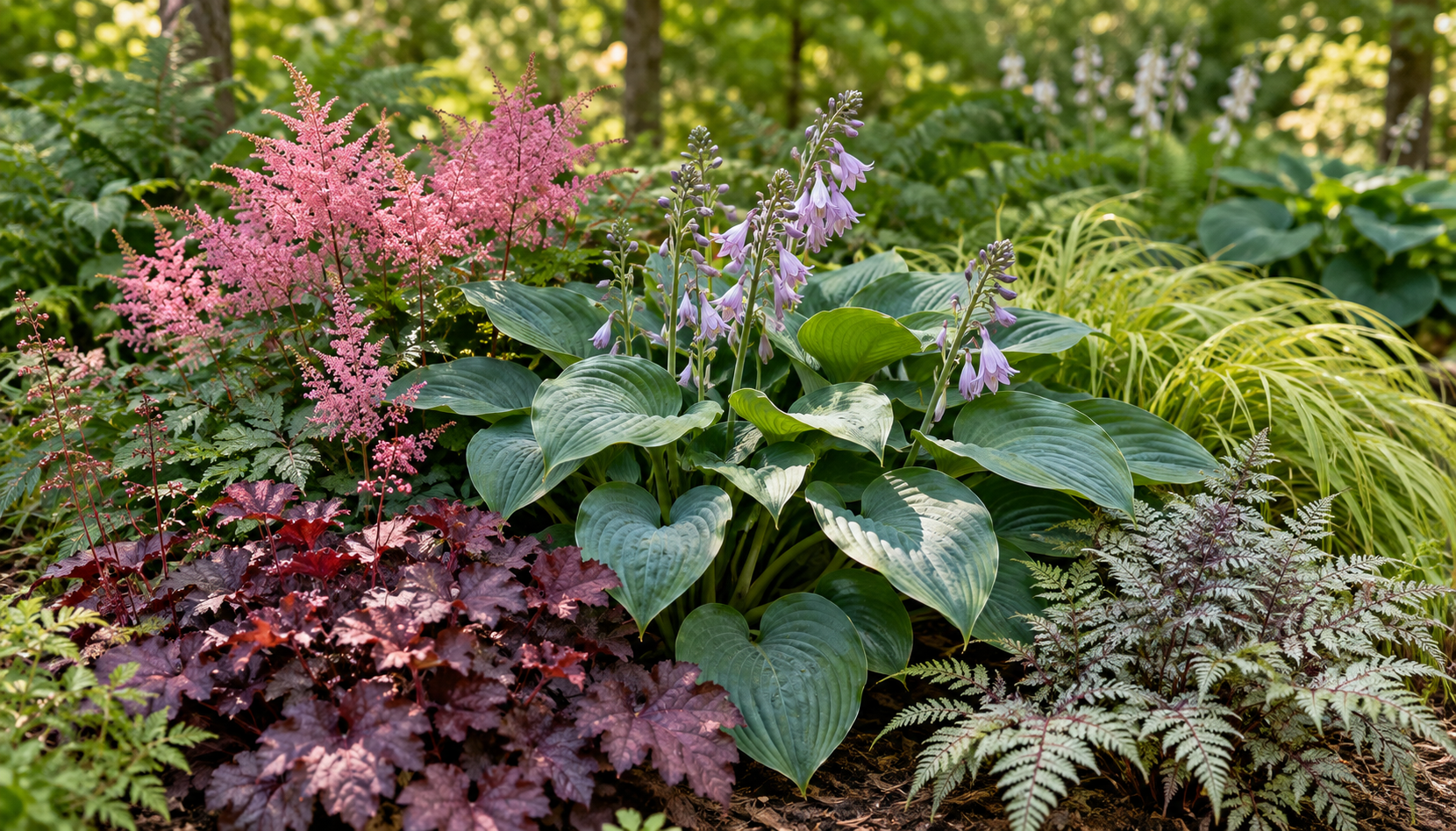
A shady garden does not have to be a dull one. Some of the most beautiful perennials grow best out of the hot sun, where their leaves stay fresh and their flowers last longer. The trick is matching the plant to the kind of shade you have, since the cool, moist shade on the north side of a house is very different from the dry shade under a big maple.
The perennials below are dependable across most of North America. They include plants grown for flowers and plants grown for their leaves, spring bloomers and fall bloomers, and options for dappled light, deep shade and dry shade, so you can build a shade garden that looks good from early spring until frost.
Quick Answer
The best perennials for shade include hosta, astilbe, coral bells, bleeding heart, Japanese forest grass, lungwort, foamflower, Solomon’s seal, hellebore, Japanese painted fern, brunnera, toad lily, Japanese anemone, bigroot geranium and epimedium. Most grow in USDA zones 3 or 4 to 8 or 9. For dry shade under trees, bigroot geranium, epimedium, hellebore and Solomon’s seal are the toughest choices.
Understanding Shade in Your Garden
Gardeners and plant labels use a few terms for shade, and knowing which one you have makes choosing plants much easier. Part shade means about 3 to 6 hours of direct sun a day, ideally in the morning, with shade during the hot afternoon. Full shade means less than 3 hours of direct sun, such as under dense trees or beside a north-facing wall. Dappled shade is filtered light through high tree branches, which suits almost every plant on this list.
Moisture matters as much as light. Moist shade, with rich soil that stays damp, is ideal for astilbe, ferns and toad lilies. Dry shade, usually under trees with shallow roots such as maples, is the hardest situation in the garden because the trees take most of the water. Only a handful of perennials thrive there, and they are noted below.
Hosta
Hosta
- Zones 3 to 9
- Light Part to full shade
- Height 6 in to 4 ft
Hostas are the backbone of the shade garden, grown for their bold leaves in blue, green, gold, cream and white. Blue varieties want the most shade, while gold varieties tolerate the most sun. They are long lived and easy, but deer and slugs love them, so plant them near the house or protect them in deer country.
Astilbe
Astilbe
- Zones 3 to 8
- Light Part shade
- Height 1 to 4 ft
Astilbe’s feathery plumes of pink, red, lavender or white rise above glossy, ferny foliage in early to midsummer. It is one of the few showy summer bloomers for shade, and deer usually leave it alone. Astilbe needs consistently moist soil; in dry conditions the leaves turn crisp and brown.
Coral Bells
Heuchera
- Zones 4 to 9
- Light Part shade
- Height 1 to 2 ft
Coral bells are grown mainly for their colorful, ruffled leaves in purple, burgundy, lime, amber, silver and nearly black, which look good from spring to fall. Airy wands of small flowers appear in late spring and early summer. Lighter-leaved varieties need more shade to avoid scorching, and all prefer well-drained soil.
Bleeding Heart
Lamprocapnos spectabilis
- Zones 3 to 9
- Light Part to full shade
- Height 2 to 3 ft
Bleeding heart’s arching stems of heart-shaped pink or white flowers are one of the highlights of the spring shade garden. The plant often goes dormant by midsummer, leaving a gap, so plant it among hostas, ferns or other perennials that fill in as it fades. It is rarely bothered by deer.
Japanese Forest Grass
Hakonechloa macra
- Zones 5 to 9
- Light Part shade
- Height 1 to 1.5 ft
Japanese forest grass forms graceful, cascading mounds that bring movement to shady beds and look beautiful spilling over edges. Gold and variegated forms such as ‘Aureola’ brighten dark corners. It grows slowly and prefers moist, well-drained soil and shelter from hot afternoon sun.
Lungwort
Pulmonaria
- Zones 3 to 8
- Light Part to full shade
- Height 9 to 12 in
Lungwort is one of the first perennials to bloom in spring, with clusters of flowers that open pink and turn blue. Its silver-spotted leaves stay attractive for the rest of the season. It tolerates drier shade better than most and is rarely eaten by deer. Choose mildew-resistant varieties for humid climates.
Foamflower
Tiarella cordifolia
- Zones 3 to 8
- Light Part to full shade
- Height 6 to 12 in
Foamflower is a North American woodland native with frothy spikes of white or pale pink flowers in spring above lobed, often burgundy-marked leaves. Some forms spread by runners into a lovely groundcover. It grows best in humus-rich, moist, well-drained soil.
Solomon’s Seal
Polygonatum
- Zones 3 to 8
- Light Part to full shade
- Height 1 to 3 ft
Solomon’s seal has elegant, arching stems lined with leaves and dangling, bell-shaped white flowers in late spring. The variegated form, Polygonatum odoratum ‘Variegatum’, lights up deep shade with its white-edged leaves. It spreads slowly and tolerates dry shade once established.
Hellebore
Helleborus × hybridus
- Zones 4 to 9
- Light Part to full shade
- Height 1 to 1.5 ft
Hellebores bloom in late winter and early spring, when almost nothing else is in flower, with nodding, long-lasting blooms in white, pink, plum, yellow and near-black. Their leathery leaves are evergreen in most climates. They are long lived, handle dry shade once established, and are highly deer resistant because every part of the plant is toxic.
Japanese Painted Fern
Athyrium niponicum ‘Pictum’
- Zones 4 to 8
- Light Part to full shade
- Height 12 to 18 in
Japanese painted fern has silvery fronds washed with burgundy stems, one of the most colorful ferns you can grow. It lights up dark spots and pairs beautifully with hostas and coral bells. It prefers moist, rich soil and is left alone by deer and rabbits.
Brunnera
Brunnera macrophylla
- Zones 3 to 8
- Light Part to full shade
- Height 12 to 18 in
Brunnera, also called Siberian bugloss, has sprays of tiny sky-blue flowers in spring that look like forget-me-nots. Varieties such as ‘Jack Frost’ have heart-shaped leaves frosted with silver that stay striking all season. It needs moist soil and protection from afternoon sun, and deer usually avoid it.
Toad Lily
Tricyrtis hirta
- Zones 4 to 9
- Light Part shade
- Height 2 to 3 ft
Toad lily blooms in late summer and fall, when most shade perennials have finished. Its small, orchid-like flowers are white or lavender, heavily spotted with purple, and reward a close look. Plant it near a path where you can see the details. It likes rich, evenly moist soil.
Japanese Anemone
Anemone × hybrida
- Zones 4 to 8
- Light Part shade
- Height 2 to 4 ft
Japanese anemone produces tall, wiry stems of pink or white, saucer-shaped flowers from late summer into fall, lighting up the shade garden at the end of the season. It takes a year or two to settle in, then spreads steadily, so give it room. It prefers moist, well-drained soil and afternoon shade.
Bigroot Geranium
Geranium macrorrhizum
- Zones 3 to 8
- Light Part to full shade
- Height 12 to 18 in
Bigroot geranium is one of the best perennials for dry shade under trees. It spreads into a dense, weed-smothering groundcover of fragrant leaves that turn red in fall, with pink or white flowers in late spring. Deer and rabbits avoid its aromatic foliage, and it needs almost no care.
Epimedium
Epimedium
- Zones 4 to 8
- Light Part to full shade
- Height 8 to 12 in
Epimedium, also called barrenwort or bishop’s hat, is another champion of dry shade. Delicate, spurred flowers in yellow, pink, white or red dance above heart-shaped leaves in spring. The foliage is often tinted red in spring and fall. Cut back old leaves in late winter so the new flowers show.
Shade Perennials at a Glance
Use this table to compare the plants above by hardiness zone, light, bloom season and what they are grown for.
| Perennial | USDA zones | Light | Bloom time | Grown for |
|---|---|---|---|---|
| Hosta | 3 to 9 | Part to full shade | Summer | Foliage |
| Astilbe | 3 to 8 | Part shade | Early to midsummer | Flowers |
| Coral bells | 4 to 9 | Part shade | Late spring to early summer | Foliage |
| Bleeding heart | 3 to 9 | Part to full shade | Spring | Flowers |
| Japanese forest grass | 5 to 9 | Part shade | Late summer | Foliage |
| Lungwort | 3 to 8 | Part to full shade | Early spring | Both |
| Foamflower | 3 to 8 | Part to full shade | Spring | Both |
| Solomon’s seal | 3 to 8 | Part to full shade | Late spring | Both |
| Hellebore | 4 to 9 | Part to full shade | Late winter to spring | Flowers |
| Japanese painted fern | 4 to 8 | Part to full shade | None | Foliage |
| Brunnera | 3 to 8 | Part to full shade | Spring | Both |
| Toad lily | 4 to 9 | Part shade | Late summer to fall | Flowers |
| Japanese anemone | 4 to 8 | Part shade | Late summer to fall | Flowers |
| Bigroot geranium | 3 to 8 | Part to full shade | Late spring | Both |
| Epimedium | 4 to 8 | Part to full shade | Spring | Both |
Best Perennials for Dry Shade
Dry shade under trees is the hardest spot in most gardens. Bigroot geranium, epimedium, hellebore, Solomon’s seal and lungwort are the most reliable choices once established. Plant them in fall or early spring so they have time to root before summer, dig planting holes between tree roots rather than cutting large roots, and water regularly for the first year. A 2-inch layer of shredded leaves or bark helps hold moisture and adds organic matter as it breaks down. Avoid piling soil over tree roots to create a raised bed, which can harm the tree.
How to Design a Shade Garden
Because most shade perennials bloom in spring, a shade garden relies on foliage for color and interest the rest of the year. Contrast leaf shapes and textures: the broad leaves of hosta, the lacy fronds of ferns, the fine blades of Japanese forest grass and the ruffled leaves of coral bells. Use light-colored foliage such as gold hostas, silver brunnera, painted fern and variegated Solomon’s seal to brighten dark corners, since pale colors show up best in low light.
Plan for a sequence of flowers: hellebores and lungwort in early spring; bleeding heart, brunnera, foamflower and epimedium in mid to late spring; astilbe in summer; and toad lily and Japanese anemone in late summer and fall. Plant in groups of three or more of each variety, and repeat a few key plants through the bed to tie it together.
Frequently Asked Questions
These are the questions gardeners ask most about perennials for shade.
What Perennials Grow in Full Shade?
Hosta, hellebore, Solomon’s seal, lungwort, foamflower, Japanese painted fern, bigroot geranium and epimedium all grow in full shade, meaning less than 3 hours of direct sun a day. Flowering is lighter in deep shade, so foliage plants carry the display.
Which Shade Perennials Bloom All Summer?
Very few shade perennials bloom continuously. Astilbe flowers in early to midsummer, and toad lily and Japanese anemone bloom from late summer into fall. For season-long color, rely on colorful foliage such as coral bells, hostas and Japanese forest grass.
How Many Hours of Sun Is Part Shade?
Part shade generally means about 3 to 6 hours of direct sun a day, ideally in the morning. Full shade means less than 3 hours of direct sun.
What Grows in Dry Shade under Trees?
Bigroot geranium, epimedium, hellebore, Solomon’s seal and lungwort are the most reliable perennials for dry shade once established. Water them regularly in their first year.
Are Shade Perennials Deer Resistant?
Many are. Astilbe, bleeding heart, hellebore, ferns, brunnera, lungwort, bigroot geranium and epimedium are rarely eaten by deer. Hostas are the main exception and are one of deer’s favorite foods.