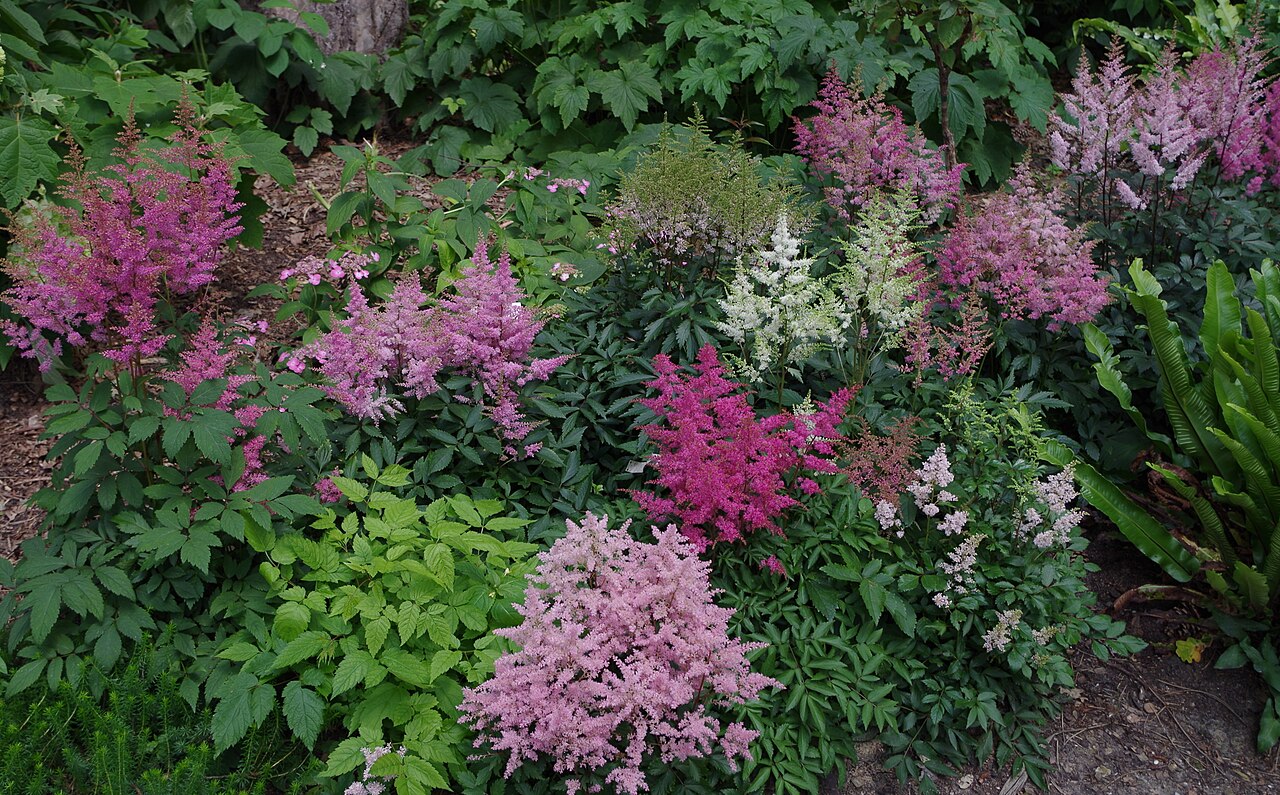
Astilbe is the flower that makes a shade garden glow. From late spring to late summer, depending on the variety, it sends up feathery plumes of pink, red, white, lavender or purple above mounds of lacy, fern-like leaves. Few perennials bring that much color to spots that get only a few hours of sun, and the foliage stays attractive long after the flowers fade.
Astilbe has one firm requirement: steady moisture. Given rich soil that never dries out and some protection from hot afternoon sun, it is long-lived, easy and ignored by deer. In dry soil or full sun, the leaves turn brown and crisp by midsummer. Nearly everything in this guide comes back to keeping the roots cool and moist.
How Do You Grow Astilbe?
Grow astilbe in part shade and rich, moist, well-drained soil in USDA zones 3 to 8, spacing plants 1 to 2 feet apart with the crowns level with the soil. Water about 1 inch a week and never let the soil dry out, mulch to hold moisture and feed with compost or a balanced slow-release fertilizer in spring. Most varieties bloom in early summer to midsummer and should be divided every 3 to 4 years.
| Botanical name | Astilbe spp. |
|---|---|
| Common names | Astilbe, false spirea, false goat’s beard |
| USDA zones | 3 to 8 |
| Sun | Part shade, with morning sun and afternoon shade; tolerates full shade with fewer flowers |
| Height | 10 inches to 4 feet, depending on variety |
| Spread | 1 to 3 feet |
| Bloom time | Late spring to late summer, depending on variety; most bloom in early summer to midsummer |
| Grown for | Both flowers and foliage |
| Flower color | Pink, red, white, lavender, purple, salmon |
| Soil moisture | Consistently moist, rich in organic matter |
| Deer | Resistant |
| Drought tolerance | Low |
| Native range | East Asia; one species native to the southeastern United States |
| Pet toxicity | Not toxic to dogs, cats or horses, according to the ASPCA |
| Maintenance | Low to moderate |
Types of Astilbe
The genus Astilbe includes about two dozen species, most of them from China, Japan and Korea. Most astilbes sold today are hybrids, grouped by the species they come from. The group affects height, bloom time and how well a plant copes with sun and dry spells, so it is worth checking the label.
Arendsii Hybrids (Astilbe × arendsii)
This is the largest and most popular group, named after the German nurseryman Georg Arends, who bred many of the classic varieties in the early twentieth century. The plants grow 2 to 3 feet tall with upright or slightly arching plumes in a wide range of colors, blooming in early summer to midsummer. They need consistent moisture and shelter from afternoon sun.
Chinese Astilbe (Astilbe chinensis)
Chinese astilbe and its hybrids, hardy in zones 4 to 8, bloom later, in midsummer to late summer, and tolerate more sun and drier soil than other astilbes. Many have stiff, upright plumes in pink, lavender and purple. The group ranges from the 10- to 12-inch groundcover ‘Pumila’ to tall varieties of 3 to 4 feet. If your site is sunnier or drier than ideal, start here.
Japanese Astilbe (Astilbe japonica)
Japanese astilbe hybrids are among the earliest to bloom, from late spring into early summer, with glossy leaves and dense, upright plumes. They grow about 18 to 24 inches tall and are often used as forced potted plants in spring.
Star Astilbe and Other Species
Star astilbe (Astilbe simplicifolia) is a compact species with less divided, glossy leaves and airy, arching plumes, best known for the variety ‘Sprite’. Thunberg astilbe (Astilbe thunbergii) has loose, drooping plumes, as in ‘Ostrich Plume’. Appalachian false goat’s beard (Astilbe biternata) is native to the southeastern United States, a large plant 3 to 6 feet tall with creamy white flowers.
Where Astilbe Grows Best
Astilbe is hardy in USDA zones 3 through 8 and grows best where summers are not too hot. In zones 7 and 8, it needs more shade and more water to get through summer, and it rarely thrives in hot, humid zone 9 gardens.
Part shade is ideal, with morning sun and shade during the hottest part of the afternoon, or bright filtered light under tall trees. Astilbe tolerates full shade, but it produces fewer and smaller plumes there. In cool northern gardens with consistently moist soil, some varieties handle full sun, although the leaves may still scorch in a hot spell.
The soil should be rich in organic matter, consistently moist and slightly acidic, with a pH of about 5.5 to 6.5. Astilbe grows naturally along streams and in moist woodlands, and it does well near ponds and in low spots, as long as the crowns do not sit in standing water over winter. Avoid planting close to large trees with shallow roots, such as maples, which compete fiercely for water.
How to Plant Astilbe
Plant astilbe in spring after the last frost or in early fall at least six weeks before the ground freezes. Work 2 to 3 inches of compost or leaf mold into the planting area. Dig a hole about twice as wide as the root ball and set the plant so the crown, where the stems meet the roots, is level with the soil surface. Backfill, firm the soil gently and water thoroughly.
Space dwarf varieties about 12 inches apart and standard varieties 18 to 24 inches apart. Astilbe looks best planted in groups of three or more of the same variety. Finish with 2 inches of shredded leaves, bark or compost to keep the soil cool and moist, keeping the mulch an inch or two away from the crowns.
Astilbe is also sold as bare-root divisions in spring. Soak them in water for an hour or two before planting, and plant them with the pink or white growth buds just at or slightly below the soil surface.
Watering and Feeding
Astilbe needs about 1 inch of water a week, and more during hot, dry weather. Water deeply at the base of the plants rather than overhead, and check the soil often in summer, especially in the first year. Soil that dries out even for a few days can scorch the leaves and shorten the flowering season. A soaker hose or drip line makes steady watering much easier.
Unlike many perennials, astilbe benefits from regular feeding. Spread a layer of compost around the plants in spring, or apply a balanced slow-release fertilizer as new growth appears. Plants that are underfed or crowded produce smaller plumes and fewer of them.
Deadheading, Cutting Back and Winter Care
Astilbe does not rebloom after its flowers fade, so deadheading does not produce more flowers. Many gardeners leave the plumes in place, since they dry to a rich brown and add texture to the garden through fall and winter. If you prefer a tidy look, cut the flower stems back to the foliage after bloom.
Leave the foliage and stems standing over winter or cut them back after a hard frost, whichever you prefer. Either way, clear the old growth to the ground in early spring before new shoots appear. In cold areas without reliable snow cover, a 2- to 3-inch winter mulch of shredded leaves after the ground freezes helps protect new plantings.
Astilbe as a Cut and Dried Flower
Astilbe plumes make good cut flowers. Cut them when about half the flowers on the plume are open, early in the morning, and put them in water right away. For dried flowers, cut the plumes when they are fully open, then hang them upside down in a dark, dry, airy spot for two to three weeks.
Dividing Astilbe
Astilbe clumps become crowded and woody in the center after a few years, and the crowns gradually rise above the soil surface, where they dry out. Divide the plants every three to four years, in spring as new growth emerges or in early fall. Lift the clump, cut it into sections with a sharp knife or spade, making sure each piece has several buds and healthy roots, and discard the old, woody center. Replant at the same depth and water well. Dividing is also the best way to rejuvenate a planting that has started to bloom less.
Best Astilbe Varieties
These varieties are dependable, widely available and cover the full range of colors, heights and bloom times.
‘Fanal’
An arendsii hybrid bred by Georg Arends, ‘Fanal’ has deep red plumes in early summer and bronze-tinted foliage. It grows about 18 to 24 inches tall and is one of the best red astilbes.
‘Bridal Veil’
A graceful arendsii hybrid with arching white plumes in early summer on plants about 2 feet tall. White astilbes light up dark corners of the shade garden, especially in the evening.
‘Visions’
A Chinese astilbe with dense, raspberry-pink plumes in midsummer on compact plants 14 to 16 inches tall. Like other chinensis types, it handles more sun and drier soil than most astilbes.
‘Sprite’
A star astilbe hybrid 15 to 18 inches tall with glossy, finely cut leaves and airy, light pink plumes in July and early August. It was introduced by the English plantsman Alan Bloom and named Perennial Plant of the Year in 1994 by the Perennial Plant Association.
‘Pumila’
A dwarf Chinese astilbe that grows only 10 to 12 inches tall and spreads faster than other astilbes into a groundcover, with lilac-pink plumes in late summer. It is one of the most drought-tolerant astilbes.
‘Purple Candles’
A tall Chinese astilbe with narrow, upright plumes of rich reddish purple in August, reaching 2 to 4 feet. It makes a strong vertical accent at the back of a shade border.
Companion Plants for Astilbe
Astilbe combines well with other shade perennials that like moist soil. The fine, ferny texture of its leaves contrasts well with the broad leaves of hostas, bigleaf ligularia and brunnera. Ferns, Japanese forest grass and sedges add movement, while coral bells and Japanese painted fern bring color through the season. For spring interest before astilbe blooms, plant bleeding heart, lungwort, hellebores and spring bulbs nearby.
Why Astilbe Doesn’t Bloom
When astilbe produces leaves but few or no plumes, the usual causes are dry soil, too much shade, crowding or poor nutrition. Plants that dry out in summer often skip blooming the following year. Deep shade under dense trees reduces flowering, and old clumps that have not been divided for many years bloom less as their centers become woody. Keep the soil evenly moist, move plants to a spot with some morning sun, divide crowded clumps and feed in spring.
Common Astilbe Problems
Astilbe is generally a healthy plant, and most problems come from dry soil or too much sun.
Brown, Crispy Leaves
Leaf scorch, when the leaves turn brown and crisp from the edges inward, is the most common astilbe problem. It is caused by dry soil, hot afternoon sun or both. Water more deeply and often, add mulch, and move plants to a shadier spot if the problem returns every summer. Scorched leaves will not recover, but the plant usually returns healthy the next spring.
Powdery Mildew and Leaf Spot
Powdery mildew leaves a white coating on the leaves, and bacterial leaf spot causes dark, angular spots. Both are worse in crowded plantings with poor air circulation. Space plants properly, water at the base and remove badly affected leaves.
Root Rot
Although astilbe loves moisture, crowns that sit in waterlogged soil over winter can rot. Plant in soil that holds moisture but drains, and avoid low spots where water pools in winter.
Pests
Spider mites can attack plants stressed by heat and drought, causing stippled, bronzed leaves. Black vine weevils notch leaf edges and their larvae feed on roots, and slugs sometimes chew young leaves. Deer and rabbits usually leave astilbe alone.
Growing Astilbe in Containers
Astilbe grows well in large containers, which is a good option for shady patios and porches. Use a pot at least 12 to 16 inches wide with drainage holes and a rich potting mix with added compost. Container plants dry out quickly, so check the soil daily in summer and water whenever the top inch feels dry. Dwarf varieties such as ‘Sprite’ and ‘Visions’ are the best choices. In zones colder than 5, move pots to an unheated garage or sink them into the ground for winter.
Frequently Asked Questions
These are the questions gardeners ask most about astilbe.
Is Astilbe a Perennial?
Yes. Astilbe is a long-lived perennial hardy in USDA zones 3 to 8. It dies back to the ground in winter and returns each spring, and a well-sited clump can last many years with division every three to four years.
Can Astilbe Grow in Full Sun?
Only in cool climates and consistently moist soil. In most gardens, full sun scorches the leaves. Chinese astilbe varieties such as ‘Visions’ and ‘Pumila’ tolerate the most sun.
Does Astilbe Spread?
Astilbe spreads slowly into wider clumps but does not run or become invasive. The dwarf Chinese astilbe ‘Pumila’ spreads faster than other astilbes and can form a groundcover.
Should You Deadhead Astilbe?
Deadheading is optional. Astilbe does not rebloom, so removing faded plumes only tidies the plant. Many gardeners leave the dried plumes standing for fall and winter interest.
Is Astilbe Toxic to Dogs?
No. The ASPCA lists astilbe as non-toxic to dogs, cats and horses, which makes it a good choice for shade gardens where pets play.
Sources
- Astilbe x arendsii, North Carolina Extension Gardener Plant Toolbox, NC State University
- Chinese Astilbe, The Morton Arboretum
- Astilbe chinensis ‘Pumila’, Chicago Botanic Garden
- Astilbe ‘Sprite’, 1994 Perennial Plant of the Year, Perennial Plant Association
- Astilbe, ASPCA Toxic and Non-Toxic Plants List