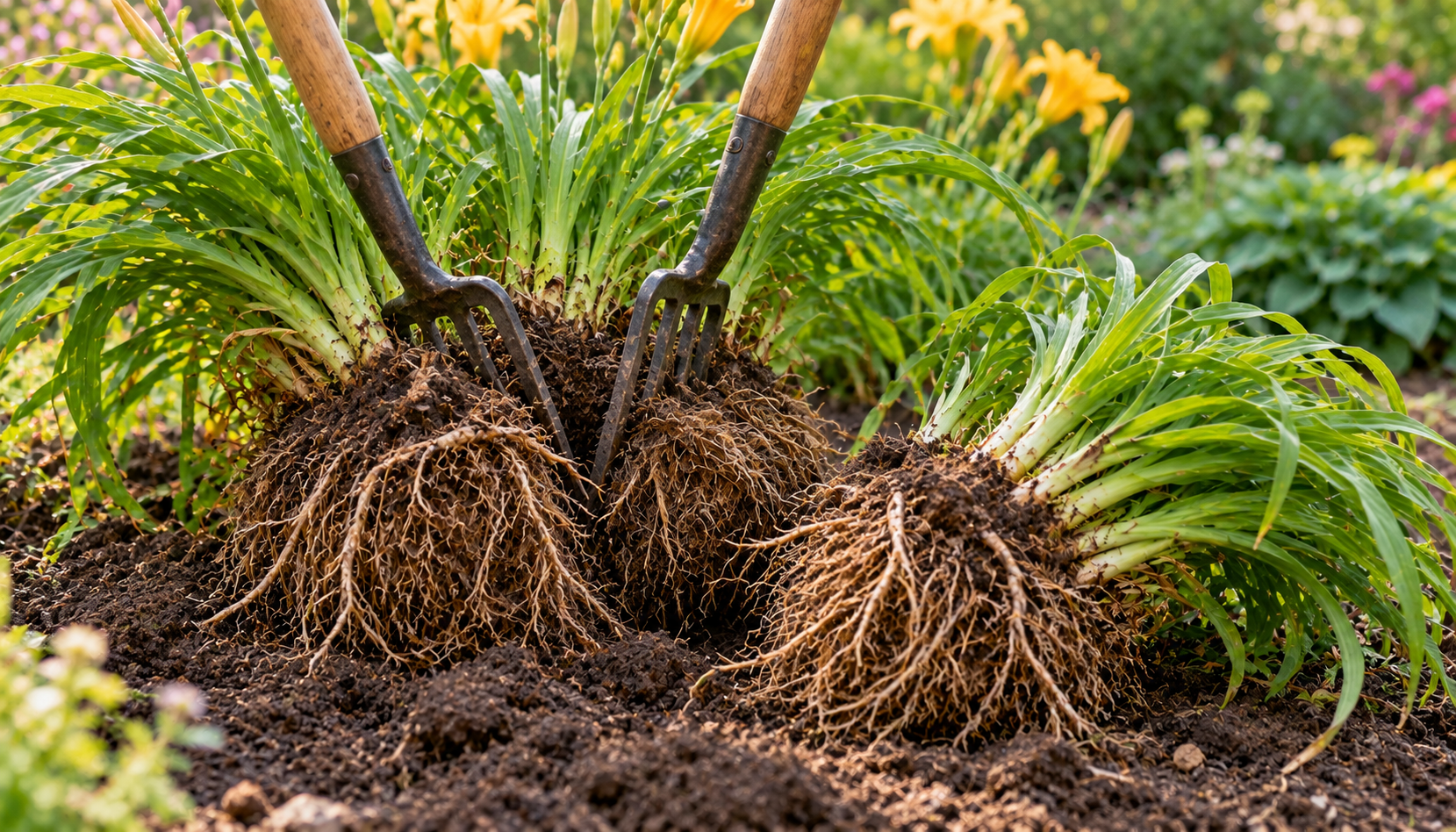
Most perennials get better with age for a few years, then start to decline. The clump spreads outward, the center goes bare and woody, flowers get smaller and fewer, and stems begin to flop. Dividing the clump into smaller pieces and replanting them resets the clock. It is one of the simplest jobs in the garden, and it pays you back twice: healthier plants, and free plants to fill new beds or give away.
The two things that matter most are timing and knowing which perennials to leave alone. Get those right and the digging itself is easy.
Quick Answer
Divide most perennials every 3 to 5 years, or whenever the center of the clump dies out or flowering drops off. Divide spring and summer bloomers in early fall, at least four to six weeks before the ground freezes, and fall bloomers in spring as new shoots emerge. Each new piece should have three to five shoots or buds and a healthy set of roots. Avoid dividing taprooted plants such as baptisia and butterfly weed.
Why Divide Perennials
Dividing keeps vigorous perennials in good shape. As a clump grows, the oldest part at the center gets crowded and exhausted, and the healthy growth moves to the outer ring. Splitting the clump and replanting the young outer sections gives the plant fresh soil and room to grow. Dividing also keeps fast spreaders from swamping their neighbors, and it is the easiest way to multiply a plant you like without buying more.
Signs a Perennial Needs Dividing
You do not need to divide on a schedule. Watch for these signs instead. The center of the clump is hollow, dead or sparse, leaving a ring of growth around a bare patch. The plant blooms less than it used to, or the flowers are smaller. Stems flop open from the middle even though the plant gets enough sun. The clump has crowded out nearby plants or outgrown its space. If a perennial is healthy, flowering well and fits its spot, leave it alone.
When to Divide Perennials
The simple rule is to divide a perennial in the season opposite its bloom time. That way the plant spends its energy on new roots, not on flowers.
Early Fall for Spring and Summer Bloomers
Early fall is the best time to divide most spring and summer bloomers, including peonies, daylilies, Siberian iris, hostas and catmint. The soil is still warm, which encourages root growth, while cooler air and more rain reduce stress on the tops. Finish the job at least four to six weeks before the ground usually freezes. In much of the northern United States and southern Canada, that means September to early October.
Spring for Fall Bloomers
Divide asters, sedum, ornamental grasses and other late-season bloomers in spring, when the new shoots are just a few inches tall. The shoots are easy to see and count, and the plant has the whole season to settle in before it flowers. Spring is also a good fallback for almost any perennial you missed in fall, as long as you divide before the plant is in active, leafy growth.
Exceptions to the Rule
Bearded iris are divided in midsummer, about six to eight weeks after they finish blooming, when the rhizomes are semi-dormant. Oriental poppies go dormant in late summer and are best divided then. Hostas are forgiving and can be split in spring as the shoots emerge or in late summer and early fall.
Perennials You Should Not Divide
Some perennials grow from a single deep taproot or a woody base rather than a spreading clump. Digging and cutting them usually does more harm than good. Baptisia, butterfly weed, balloon flower, lupine and gas plant fall into this group. Hellebores and Russian sage also resent disturbance. Peonies can be divided, but they rarely need it and often sulk for a year or two afterward. If you want more of these plants, grow them from seed, take cuttings or buy new ones.
How to Divide Perennials
Pick a cool, cloudy day if you can, and water the plant well the day before so the roots and soil hold together. Have the new planting holes ready, or a shady spot and a bucket of water to hold divisions while you work.
Tools You Need
A sharp spade and a garden fork will handle most jobs. A sturdy knife or an old bread knife is useful for cutting through dense crowns. For very large or woody clumps, such as mature ornamental grasses or giant hostas, a pruning saw or even an axe makes quick work of it.
Step One: Cut Back the Foliage
For fall and summer division, cut the foliage back by about half. Fewer leaves means less water loss while the roots re-establish. In spring, the new shoots are small enough that no trimming is needed.
Step Two: Lift the Clump
Dig a circle around the plant at the edge of its foliage, going straight down with the spade. Work around the circle, then lever the whole clump out of the ground with the spade or fork. Big clumps are heavy, so it is fine to cut them into halves or quarters in the hole and lift each piece separately.
Step Three: Split the Clump
Shake or hose off the loose soil so you can see the shoots, buds and roots. How you split it depends on the plant. Loose clumps like catmint and asters pull apart by hand. Tight, fibrous clumps like daylilies separate well with two garden forks pushed in back to back and pried apart. Dense crowns like hostas and astilbe need to be cut with a spade or knife. Aim for pieces with three to five shoots or buds and a good mass of roots. Throw away the dead, woody center.
Step Four: Replant Right Away
Replant divisions at the same depth they were growing before, in soil loosened and improved with compost. Firm the soil around the roots and water thoroughly to settle it. Do not let divisions sit in the sun and dry out. If you cannot plant them all at once, pot them up or wrap them in damp burlap and keep them in the shade.
When and How Often to Divide Common Perennials
Use this table as a guide for the perennials most gardeners grow. How often depends on your conditions, so let the plant’s condition be the final judge.
| Perennial | When to divide | How often |
|---|---|---|
| Aster | Spring | Every 2 to 3 years |
| Bee balm | Spring | Every 2 to 3 years |
| Catmint | Spring or early fall | Every 3 to 4 years |
| Coral bells | Spring | Every 3 to 4 years |
| Astilbe | Spring or early fall | Every 3 to 4 years |
| Bearded iris | Midsummer, after bloom | Every 3 to 4 years |
| Sedum | Spring | Every 3 to 4 years |
| Daylily | Early fall or spring | Every 3 to 5 years |
| Siberian iris | Early fall or spring | Every 3 to 5 years |
| Ornamental grasses | Spring | Every 3 to 5 years |
| Hosta | Spring or early fall | Only when needed |
| Peony | Early fall | Rarely; only when needed |
| Baptisia | Do not divide | Never |
| Butterfly weed | Do not divide | Never |
| Hellebore | Avoid | Rarely, if ever |
Tips for Specific Perennials
A few popular perennials have quirks worth knowing before you dig.
Hostas
Hostas are easiest to divide in early spring when the shoots are just poking through, because you can see every bud and avoid damaging the leaves. Mature clumps can be tough enough to need a saw. You can also slice a wedge out of the side of a clump without lifting the whole plant.
Peonies
Divide peonies only in early fall, and only if the clump has become too large or stopped blooming well. Each division needs three to five eyes, the pink buds on top of the root. Replant with the eyes no more than 2 inches below the surface, or 1 inch in warmer zones. Planting too deep is the most common reason divided peonies fail to bloom.
Coral Bells
Coral bells tend to push up out of the ground over time, leaving a bare woody stem below the leaves. When you divide them in spring, replant each piece deeper so that the woody stem is buried and only the leaves sit above the soil.
Bearded Iris
Lift the clump, cut the healthy young rhizomes from the outside with a few inches of leaves attached, and discard the old central rhizomes. Trim the leaves to about 6 inches, then replant with the top of the rhizome just at or slightly above the soil surface, where it can bake in the sun.
Daylilies
Daylilies form dense, fibrous clumps that are hard to split with a spade alone. Push two garden forks into the center of the lifted clump, back to back, and pry the handles apart. Repeat until you have fans of leaves with roots attached. Each division should have at least two or three fans for a good show the following year.
Ornamental Grasses
Divide grasses in spring just as new growth begins. Warm-season grasses such as switchgrass and little bluestem start late, so wait until you see green at the base. Mature clumps can be extremely tough, and a pruning saw or axe is often the right tool. Replant only the healthy outer sections; the center of an old grass clump is usually dead.
Common Dividing Mistakes
Dividing at the wrong time is the biggest mistake. A perennial split in full bloom or in summer heat has to support its flowers and leaves while regrowing roots, and it often wilts badly or dies. Stick to the season opposite the bloom time, and water well if you have to move something at an awkward time.
Making divisions too small is the next. Tiny single-shoot pieces can survive, but they take years to reach flowering size. Pieces with three to five shoots establish much faster. Replanting at the wrong depth causes the rest of the trouble: peonies planted too deep will not bloom, bearded iris planted too deep rot, and coral bells planted too high dry out.
Finally, do not let divisions dry out between lifting and replanting. Roots exposed to sun and wind for even an hour can be badly damaged. Keep them covered and damp, and get them into the ground as soon as you can.
Caring for New Divisions
Water new divisions deeply about once a week, aiming for roughly 1 inch of water, for the first four to six weeks unless rain does the job. Once the ground freezes, cover fall divisions with 2 to 4 inches of shredded leaves or bark mulch to prevent frost heaving. Skip fertilizer until the following spring.
Expect divisions to look a little thin in their first season. Most perennials fill out and bloom normally by the second year. If you ended up with more divisions than you have room for, pot up the extras for friends and neighbors, or plant them in a nursery row to grow on until you need them.
Frequently Asked Questions
These are the questions gardeners ask most about dividing perennials.
Can You Divide Perennials in Summer?
You can, but it is the hardest time for the plant. If you must divide in summer, do it on a cloudy day, cut the foliage back by half, replant immediately and water every day or two until the plant stops wilting. Bearded iris are the exception, since midsummer is their preferred time.
Will Divided Perennials Bloom the First Year?
Many will, especially fast growers like asters, bee balm and catmint divided in spring. Slower plants such as peonies, hostas and Siberian iris often bloom lightly or skip a year while they rebuild their roots. Larger divisions bloom sooner than small ones.
How Small Can a Division Be?
As long as a piece has at least one healthy shoot or bud and some roots, it can grow into a new plant. For a division that looks good and flowers the following season, aim for three to five shoots or buds.
Can You Divide a Perennial without Digging It Up?
Yes, for many clump-formers. Push a sharp spade straight down through the clump to cut off a wedge from the outside edge, lift that wedge out, and fill the gap with compost and soil. This works well for hostas, daylilies and ornamental grasses, and it leaves the parent plant undisturbed.
How Long Can Divisions Stay out of the Ground?
Ideally, no more than a few hours. If you need to hold them longer, pot them up in moist potting mix or wrap the roots in damp burlap or newspaper and keep them in the shade. Most perennials will hold for a few days this way.